
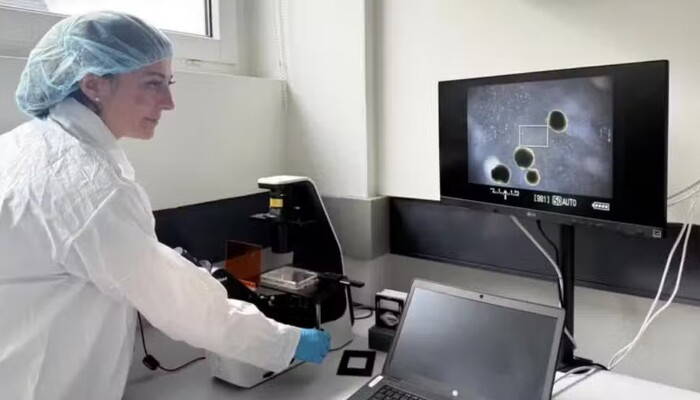
In a groundbreaking experiment, scientists in Switzerland have successfully grown mini human brains, or organoids, to be used as living processors in computers. This fusion of biology and technology, known as biocomputing, could revolutionize the future of artificial intelligence and energy-efficient computing systems.
Building Brains from Skin Cells
At the cutting-edge FinalSpark laboratory, researchers are creating brain-like organoids using human skin cells. These cells are reprogrammed to form clusters of neurons, which are then connected to electrodes that allow them to send and receive electrical signals.
According to Dr. Fred Jordan, co-founder of FinalSpark, these living systems—often referred to as “wetware”—can learn and adapt in ways that traditional silicon chips cannot. “We’re building computers that actually think — using living cells,” he said, emphasizing the vast potential of the technology.
How Biocomputing Works
Each organoid functions as a biological processor, with neurons transmitting electrical impulses much like they do in the human brain. By connecting multiple organoids together, scientists can create a network capable of processing information.
These mini-brains are kept alive in carefully controlled lab environments using nutrient-rich fluids. However, they remain fragile and can only survive for about four months, as they lack the blood vessels required for long-term sustenance. Maintaining their viability is one of the biggest challenges researchers face.
Read: Game Pass Price Hike Sparks Cancelations and Frustration
A Leap Toward Energy-Efficient Computing
Traditional computers rely on silicon chips, which consume vast amounts of energy and generate significant heat. In contrast, biocomputers built from living cells could operate at a fraction of the energy cost.
Dr. Jordan explained that neurons are far more efficient at processing and storing information than transistors. “The human brain uses just 20 watts of energy to perform tasks that require megawatts for a supercomputer,” he said. “Our goal is to harness that natural efficiency.”
This efficiency could transform how data centers operate. As global demand for computing power increases, especially for AI and machine learning, biocomputers might offer an eco-friendly alternative.
Early Signs of Learning
Despite their small size—each organoid contains only a few hundred thousand neurons compared to the human brain’s 86 billion—these mini-brains are already showing remarkable abilities.
In experiments, the neurons have responded to external stimuli and adapted to changing signals. Some studies suggest that they may even display rudimentary learning behavior. Researchers believe that, in time, these systems could be trained to recognize patterns, process data, or interact with artificial intelligence algorithms.
Challenges and Ethical Concerns
Keeping organoids alive and functional remains difficult. Without a circulatory system, they struggle to receive sufficient nutrients and oxygen. Scientists are exploring techniques to extend their lifespan, including embedding them in microfluidic systems that mimic blood flow.
Beyond technical challenges, ethical questions are also emerging. Some experts are debating whether these organoids, as they become more complex, could experience forms of awareness or consciousness. Regulators are now closely watching biocomputing experiments to ensure that research follows ethical standards.
A Global Race Toward Living Computers
Switzerland is not alone in this frontier. Teams in Australia and the United States are also developing organoid-based computing systems. In one notable project, researchers trained brain cells to play simple video games like Pong by responding to digital feedback signals.
These international collaborations aim to understand both how the brain processes information and how biological intelligence can enhance artificial systems. Scientists see this as a bridge between neuroscience and computer engineering, potentially leading to breakthroughs in medical research, robotics, and machine learning.
Potential Uses Beyond AI
Experts believe biocomputers could play a vital role in studying neurological diseases such as Alzheimer’s, epilepsy, and autism. Since organoids mimic brain function, researchers can observe how neural networks behave under specific genetic or chemical conditions, allowing for more precise drug testing.
Dr. Jordan said the technology’s impact could extend well beyond AI. “By combining biology with computing, we’re opening doors to understand the human mind—and to build machines that work more like it,” he noted.
The Future of Biocomputing
While the field is still in its infancy, progress is accelerating. If scientists can overcome the challenges of keeping organoids alive and stable, biocomputers could redefine the limits of processing power and intelligence.
As Dr. Jordan put it, “What once felt like science fiction is becoming real. We’re not just building faster computers—we’re teaching living systems to compute.”
For now, these tiny human-brain organoids represent both a technological milestone and a profound scientific question: how close can we come to merging life with machine?
Follow us on Instagram, YouTube, Facebook,, X and TikTok for latest updates
