
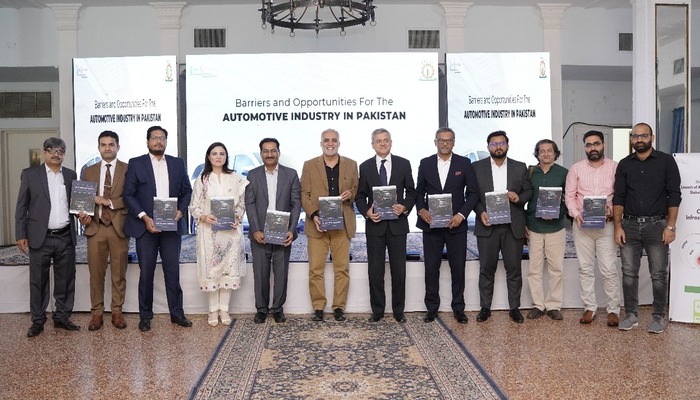
Pakistan’s automotive industry must accelerate its green mobility transition, experts and industry leaders said at a stakeholder dialogue in Karachi on Tuesday. They urged the government to ensure consistent policy implementation, invest in charging infrastructure, and provide financial incentives to boost the adoption of electric and hybrid vehicles.
Dialogue Highlights
The discussion took place during the event “Shifting Gears: Launch of Automotive Study and Stakeholder Dialogue” organized by the Indus Consortium. The event also marked the release of a detailed research study titled “Green Transition – Barriers and Opportunities for the Automotive Industry in Pakistan,” conducted in collaboration with the Federation of Pakistan Chambers of Commerce and Industry (FPCCI).
Speakers emphasized that sustainable mobility was not limited to electric vehicles (EVs) but included hybrid and plug-in hybrid models that could help bridge Pakistan’s transition toward cleaner transportation.
Industry Voices Call for Practical Reforms
Ali Asghar Jamali, CEO of Indus Motor Company (IMC), said his company was taking tangible steps toward carbon reduction. He highlighted IMC’s rooftop solar power installation — the largest in the country — and the introduction of hybrid electric vehicles (HEVs).
He stressed that a total shift to EVs would not solve the emissions problem unless Pakistan’s electricity generation became cleaner. “With 62 percent of our electricity coming from fossil fuels, simply switching to EVs won’t bring the environmental gains we expect,” Jamali explained.
Hussain Jarwar, CEO of Indus Consortium, added that Pakistan’s New Energy Vehicle (NEV) Policy could succeed if financing and infrastructure barriers were addressed. “Just as solarisation has transformed the energy landscape, the NEV Policy can do the same for transportation,” he said.
Localization Seen as Key
Aamir Allawala, former Chairman of the Pakistan Association of Automotive Parts and Accessories Manufacturers (PAAPAM), said that true benefits of the green shift would emerge only after Pakistan began localizing parts for new energy vehicles. He also warned that EV battery disposal could become a significant environmental challenge in the future.
Read: US to Supply Pakistan with Advanced AMRAAM Missiles
Findings from the FPCCI Study
Presenting the study, Muhammad Armughan of FPCCI said the research focused on Scope 3 emissions from IMC’s value chain and outlined practical ways to reduce them. “Pakistan’s auto sector contributes a large share of national emissions, but we can change this through targeted incentives, technology transfer, and access to green financing,” he noted.
The study called for clear fiscal support and long-term investment in sustainable technologies to help Pakistan meet its carbon reduction commitments.
Financing Challenges Remain
Representatives from the banking sector also discussed the limited financing available for green vehicles. Rashid Azeem from UBL, Wajih Zaman from Soneri Bank, and Sadia Bukhari from Sindh Bank highlighted that most vehicle loans currently cap at Rs3 million, restricting access to new energy vehicles.
However, they added that the government was considering subsidies for two- and three-wheeler EVs, covering down payments and offering interest-free loans. “Smaller EVs can be the foundation of Pakistan’s clean mobility transformation,” one banker remarked.
Barriers to a Green Transition
Panellists agreed that achieving NEV Policy targets would be difficult without coordinated reforms. They pointed out the key obstacles: a shortage of charging infrastructure, high upfront costs, and Pakistan’s reliance on fossil fuels for power generation.
The study found that Pakistan currently operates only 35 public charging stations, lagging behind regional countries such as India and Nepal. With nearly 60 percent of its electricity derived from fossil fuels, experts warned that electric mobility without power sector reform would merely shift emissions from vehicles to power plants.
Opportunities for Growth
Despite these challenges, the report identified several opportunities. Local assembly of hybrid models by IMC and the planned entry of Chinese EV manufacturer BYD could boost domestic clean vehicle production. The experts suggested mandating a fixed share of hybrid and electric vehicles in overall production targets to accelerate market growth.
They also proposed a strong Extended Producer Responsibility (EPR) framework to ensure the recycling of used batteries and end-of-life vehicles. “We must build an ecosystem that supports the entire life cycle of green vehicles — from production to disposal,” the study said.
Key Policy Recommendations
The report urged the government to create a national task force to oversee the implementation of EV and hybrid vehicle policies. It recommended the development of a nationwide charging network supported by reduced electricity tariffs for EVs.
Hybrid vehicles, the study noted, should be integrated into Pakistan’s broader electric mobility strategy to provide a realistic bridge between fossil fuel and fully electric transport.
Financial institutions were encouraged to introduce green car financing products with lower interest rates and longer repayment terms. Insurance companies, meanwhile, were advised to offer premium discounts for environmentally friendly vehicles.
Building Consensus for Action
Other speakers, including Fatima Majeed from the Fishermen’s Cooperative Society, Prof. Dr. Raza Ali Khan from NED University, and Yasir Hussain from the Climate Action Centre, echoed the need for collaboration between government, academia, and private industry.
They agreed that a gradual but steady approach toward cleaner transport was more achievable than a rapid overhaul. Pakistan, they said, could not afford to delay green mobility reforms any longer given its rising emissions and worsening air quality.
Toward a Sustainable Auto Future
The event concluded with a call for immediate policy action to accelerate Pakistan’s green mobility journey. Participants from government, industry, finance, and civil society expressed optimism that consistent policy support, fiscal incentives, and infrastructure development could put the country on the road to a sustainable automotive future.
Follow us on Instagram, YouTube, Facebook,, X and TikTok for latest updates
