
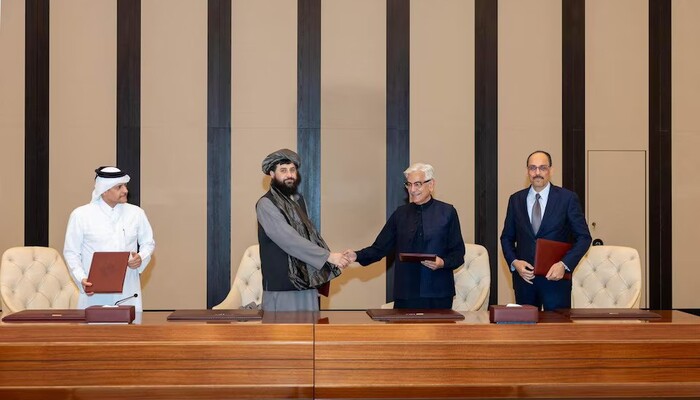
After a week of intense cross-border violence, Pakistan and Afghanistan agreed to an immediate ceasefire following peace talks in Doha on Sunday. The Pakistan-Afghanistan ceasefire reflects a major diplomatic breakthrough after the deadliest clashes between the two neighbors since the Taliban took power in 2021. The agreement, mediated by Qatar and Turkey, signals a renewed attempt to prevent further bloodshed and stabilize a volatile border region long troubled by militant activity.
A Turning Point in a Tense Relationship
The ceasefire came after days of escalating hostilities that left dozens dead and hundreds wounded. Both sides faced mounting international pressure to halt the violence that threatened to spiral into a larger conflict.
Pakistan’s Defense Minister Khawaja Muhammad Asif and Afghanistan’s Defense Minister Mullah Mohammad Yaqoob Mujahid signed the agreement during the Doha negotiations. The two leaders emphasized their commitment to peace and agreed to meet again on October 25 in Istanbul to discuss detailed terms for long-term stability.
In a post on X, Asif confirmed that the ceasefire “has been finalized,” expressing optimism that further dialogue would help rebuild trust between the two nations.
Qatar and Turkey Lead Mediation
Qatar’s foreign ministry, in coordination with Turkey, played a crucial role in bringing both parties to the negotiation table. Their joint mediation marked one of the most significant regional diplomatic efforts since the Taliban’s return to power.
Qatari officials stated that follow-up meetings in Istanbul would focus on ensuring “the sustainability of the ceasefire and verifying its implementation in a reliable and lasting manner.” Both mediators urged continued restraint, highlighting the importance of direct communication channels to prevent misunderstandings along the contested border.
Read: Pakistan, Afghanistan Hold High-Stakes Talk Amid Tensions
Root Causes of the Conflict
The latest clashes erupted after Pakistan accused Kabul of harboring militants from the Tehreek-e-Taliban Pakistan (TTP), a group responsible for multiple deadly attacks inside Pakistan. Islamabad demanded that Afghanistan rein in these fighters, claiming they were using Afghan territory as a base for operations.
Afghanistan, however, denied direct involvement, calling for mutual dialogue and respect for sovereignty. The tension rapidly escalated into ground skirmishes and airstrikes along their 2,600-kilometer border, known as the Durand Line — a historical flashpoint between the two nations.
Pakistan’s airstrikes targeted alleged militant hideouts inside Afghan territory, prompting retaliation from Taliban forces stationed near the frontier. Local reports indicated severe casualties on both sides, as villages near the border became battlegrounds.
Taliban’s Response and Commitments
Following the ceasefire announcement, Taliban spokesperson Zabihullah Mujahid confirmed that both sides had agreed to a “complete and meaningful ceasefire.” He assured that Kabul would not allow any group to use Afghan soil for attacks against Pakistan.
This assurance marked a significant policy statement by the Taliban government, which has been under pressure from regional powers to control transnational militant movements. Mujahid called the agreement “a step toward peace and mutual respect,” emphasizing Afghanistan’s interest in stable relations with its eastern neighbor.
Regional and Global Reactions
The ceasefire was welcomed across the region. Diplomats from China, Iran, and the United States quietly supported the Qatari-led mediation, recognizing that continued violence could disrupt trade routes and regional security.
Analysts noted that both Islamabad and Kabul faced internal challenges that made sustained conflict unsustainable. Pakistan continues to grapple with rising militant attacks and economic difficulties, while Afghanistan faces international isolation and humanitarian crises.
By agreeing to talks, both sides have demonstrated a willingness to shift from confrontation to cooperation — at least temporarily.
Challenges Ahead for Peace Implementation
Despite the breakthrough, analysts warn that maintaining the Pakistan-Afghanistan ceasefire will require constant monitoring and mutual goodwill. The border region remains heavily militarized, and local commanders often act independently of central authority, posing risks of renewed skirmishes.
Pakistan’s defense officials said that mechanisms for communication and incident reporting would be discussed in Istanbul. These could include joint border committees and intelligence-sharing channels to prevent future misunderstandings.
Afghanistan’s leaders, meanwhile, face the challenge of proving they can curb militant groups operating within their territory — a condition Pakistan views as essential for lasting peace.
Symbolism of the Doha Talks
The Doha meeting carried symbolic importance beyond the ceasefire itself. It showcased the growing diplomatic role of Qatar and Turkey as mediators in South Asian affairs, filling a vacuum left by Western disengagement from Afghanistan.
For the Taliban government, participating in high-level peace talks also represented a rare moment of international legitimacy. For Pakistan, it was a chance to reassert its regional influence while avoiding prolonged conflict along its western frontier.
A Fragile but Hopeful Pause
While the ceasefire offers a temporary relief from violence, both nations face a long road toward rebuilding trust. The border dispute, deeply rooted in history and politics, continues to fuel suspicion on both sides.
Still, the events in Doha mark a hopeful pause. For the first time in years, the two neighbors are openly communicating about peace rather than exchanging fire. If both capitals honor their commitments in the coming weeks, the Pakistan-Afghanistan ceasefire could evolve into a foundation for broader regional stability — a goal long sought but rarely achieved.
Follow us on Instagram, YouTube, Facebook,, X and TikTok for latest updates
