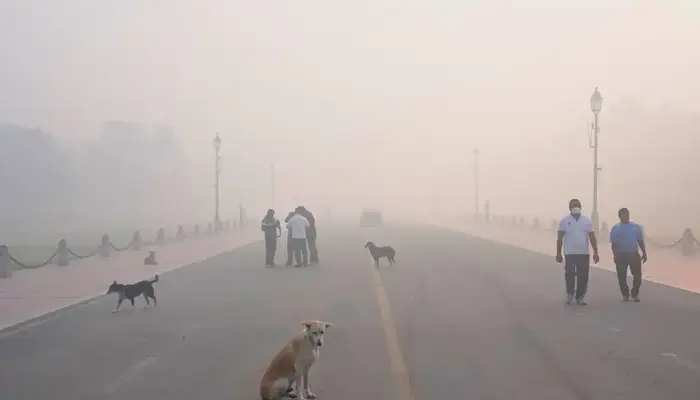
India’s air pollution monitoring stations struggled to record the full scale of toxic smog in New Delhi after pollution levels exceeded their maximum measurement capacity during Diwali celebrations, raising questions about the accuracy of official air quality data.
Authorities acknowledged that some monitoring stations recorded gaps after particulate matter concentrations crossed their calibrated measurement limits. The readings came amid an intense pollution surge caused by fireworks during the Hindu festival of lights.
Opposition politicians accused the authorities of deliberately allowing gaps in pollution records during the hours when air quality deteriorated sharply. However, the Central Pollution Control Board (CPCB) rejected allegations of data manipulation, attributing the missing readings to technical limitations.
New Delhi regularly experiences hazardous air quality during winter as vehicle emissions, industrial pollution and agricultural fires combine to produce thick smog across the capital.
The latest episode has intensified concerns about the city’s ability to monitor and respond to severe pollution events.
Air Quality Monitors Exceed Their Measurement Capacity
The CPCB said particulate matter analysers installed under India’s National Air Quality Index (NAQI), introduced in 2015, were calibrated to measure concentrations of up to 1,000 micrograms per cubic metre.
However, the monitoring system automatically excludes hourly readings that exceed the instruments’ calibrated range during data validation.
In a statement issued late Tuesday, the pollution regulator explained that such extreme episodes could create apparent gaps in monitoring records, particularly during occasions involving widespread firecracker use.
The World Health Organisation (WHO) recommends a daily average PM2.5 concentration of no more than 15 micrograms per cubic metre.
PM2.5 refers to extremely fine airborne particles that can penetrate deep into the lungs and enter the bloodstream, increasing the risk of serious respiratory and cardiovascular diseases.
The reported pollution surge was equivalent to approximately 66 times the WHO’s recommended daily maximum, according to the reported comparison.
Read more: Imran Khan Taken to Pims for Overnight Eye Treatment, Discharged at 2:30am
Opposition Questions Missing Diwali Pollution Readings
The missing data triggered criticism from opposition politicians, who questioned why several monitoring stations failed to provide readings during the hours when fireworks intensified air pollution.
Aam Aadmi Party (AAP) Delhi president Saurabh Bharadwaj accused the government of undermining public confidence in official pollution records.
“The government which shuts down air quality monitoring stations on the night of Diwali, the government that does data fraud, how will you trust such a government?” he said in a video shared on X.
Senior Congress leader Ajay Maken also questioned the absence of PM2.5 readings during the peak pollution period.
“If Diwali night’s PM2.5 (toxic particulates) is not in the record, who will answer for that air?” he wrote on social media.
The CPCB denied deliberately suppressing pollution information and maintained that the gaps resulted from technical restrictions rather than an attempt to conceal worsening air quality.
PM2.5 Levels Reach 879 in Delhi Locality
Although monitoring stations initially failed to capture the full pollution surge, readings resumed approximately eight hours after fireworks peaked.
Data cited by air quality monitoring organisation IQAir showed PM2.5 concentrations reaching 879 micrograms per cubic metre in Delhi’s Mandir Marg locality.
The reading, attributed to a city government monitoring station, was more than 58 times the WHO’s recommended daily maximum.
The figures highlighted the severity of the pollution episode and renewed concerns about the health risks facing residents.
Read more: Gaza Winter Storm Flooding Hits 70,000 Tents, More Disasters Feared
Congress leader Pawan Khera criticised the missing readings, arguing that gaps in official records did not mean the pollution itself had disappeared.
“There is one thing the people of Delhi can be certain of: the fact that the data has gone missing doesn’t mean the pollution has disappeared too,” he said.
He warned that exposure to poisonous smoke could damage people’s lungs, threaten their lives and reduce life expectancy.
Delhi Faces Recurring Winter Pollution Crisis
Delhi’s pollution crisis intensifies during winter, when stagnant atmospheric conditions trap pollutants close to the ground.
Vehicle exhaust, industrial emissions, construction dust and smoke from agricultural fires contribute to the deteriorating air quality. Fireworks during Diwali can add another significant burst of particulate pollution.
The latest monitoring failure has raised questions about whether existing air quality instruments can adequately capture extreme pollution events.
The controversy also highlights the importance of transparent environmental monitoring, particularly when millions of residents depend on accurate pollution information to protect their health.
While the CPCB has defended its monitoring system, opposition parties continue to question the reliability of official records during the most severe pollution episodes.