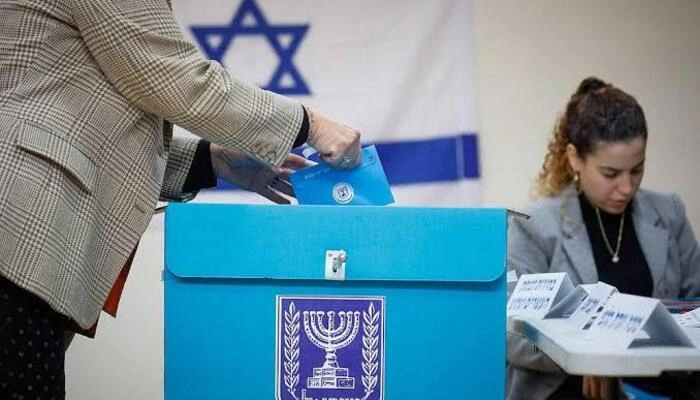
Israel’s election deadlock has left Prime Minister Benjamin Netanyahu and his main rival, Gadi Eisenkot, without a clear path to power, according to exit polls released after record voter turnout on Tuesday. The projections suggest that neither political bloc has secured the 61 seats required to form a majority government in the 120-member Knesset, raising the possibility of prolonged coalition negotiations or another election.
The election marked Israel’s first national vote since the Hamas-led attacks of October 7, 2023, and the subsequent wars in Gaza, Lebanon and Iran. The results could determine the political future of Netanyahu, who has served as prime minister for nearly 19 of the past 30 years.
According to exit polls released by major Israeli television networks, the opposition bloc led by Eisenkot was projected to win between 52 and 53 seats. Netanyahu’s Likud-led alliance was expected to secure around 50 seats, while Arab parties were projected to win between 17 and 18 seats.
However, the projections varied across Israeli media outlets. Channel 14, which is considered supportive of Netanyahu, offered a more favourable estimate for the prime minister’s alliance, projecting that his bloc could secure 60 seats. Official results will determine the final distribution of seats.
Netanyahu Faces Challenge From Opposition
The preliminary results represent a setback for Netanyahu, whose right-wing coalition has faced growing criticism over security failures, domestic political divisions and Israel’s international isolation.
Opposition leader Yair Lapid said Netanyahu’s political bloc had suffered a major defeat, arguing that voters had rejected the continuation of his government.
Read more: Trump Compares Abdul El-Sayed to 9/11 Attackers Ahead of Michigan Senate Election
Despite the opposition’s projected lead, the fragmented nature of Israel’s parliamentary system means that securing a majority will require negotiations with other parties. Smaller political groups could play a decisive role in determining who forms the next government.
Netanyahu could remain in office in a caretaker capacity while political leaders attempt to assemble a governing coalition. If negotiations fail to produce a viable government, Israel could face another election.
The election results also highlighted the difficulty Netanyahu’s opponents face in building a united political alliance. Although several parties campaigned against his continued leadership, differences over security, military service and cooperation with Arab parties could complicate efforts to form a stable government.
Record Turnout Marks Election Day
Israeli voters turned out in large numbers, making the election one of the country’s most significant electoral contests in decades.
The Central Elections Committee reported that nationwide turnout reached 77.7%, the highest level in more than two decades, according to reporting on the preliminary results. Long queues formed outside polling stations as voters considered the government’s handling of the October 7 attacks and the conflicts that followed.
For many opponents of Netanyahu, the election represented an opportunity to demand accountability for the security failures surrounding the Hamas-led attacks. Opposition groups have called for a national inquiry into the events, while Netanyahu has resisted calls for such an investigation.
Netanyahu has defended his leadership by emphasising national security and his government’s efforts to confront threats facing Israel. He also campaigned on his relationship with US President Donald Trump, who has supported him during the conflict with Iran.
The prime minister urged supporters to vote in large numbers, warning that low participation among his political base could undermine his chances of retaining power.
Israeli Arab Voters Could Influence Government Formation
Participation among Israel’s Arab citizens emerged as another important factor in the election.
Arab parties were projected to secure a substantial share of parliamentary seats, potentially giving them significant influence over efforts to form a government. Their support could become crucial if the opposition bloc attempts to assemble a majority or establish a minority government with backing from parties outside the coalition.
Netanyahu criticised the participation of Arab voters during his campaign, raising concerns about their potential impact on the outcome. His remarks prompted allegations of intimidation from members of the minority community.
The election also produced a strong response at the headquarters of the Joint List, an alliance of Arab parties, where supporters celebrated the projected results as polling stations closed.
The role of Arab parties in coalition negotiations remains uncertain, particularly because cooperation with them has been a contentious issue among several Jewish-led political groups.
Eisenkot Emerges as Netanyahu’s Main Challenger
Eisenkot, a former chief of the Israeli military, emerged as the leading challenger to Netanyahu. He has presented himself as a security-focused alternative while advocating a different approach to domestic political leadership.
Eisenkot entered politics several years ago and joined Netanyahu’s wartime leadership framework following the October 7 attacks. He later left, criticising the prime minister’s leadership.
His military background has helped him appeal to voters concerned about national security and the government’s response to the attacks. The deaths of his son and two nephews in the Gaza conflict have also shaped his public profile.
However, even a narrow victory for the opposition bloc would not automatically guarantee Eisenkot the premiership. He would still need to secure sufficient parliamentary support to establish a government.
Israel Faces Uncertain Political Future
The Israel election deadlock leaves the country facing a period of political uncertainty as parties assess the preliminary results and prepare for coalition negotiations.
Netanyahu’s opponents may gain the first opportunity to explore forming a government if the final results confirm the exit polls. Nevertheless, the prime minister’s political experience and established support base could allow him to remain influential during negotiations.
The outcome will also shape Israel’s domestic policies and its approach to the conflicts in Gaza, Lebanon and Iran, as well as its relations with international partners.