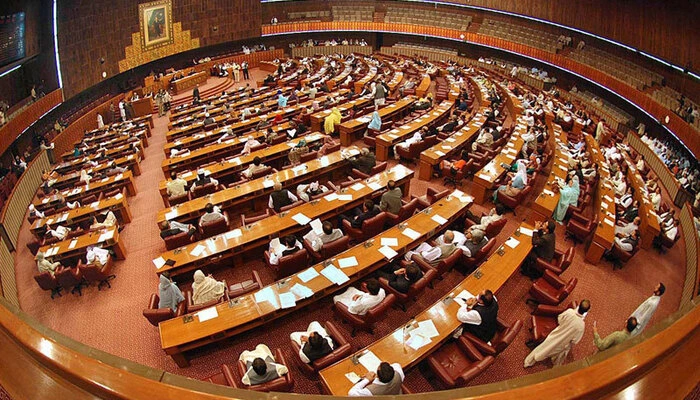
The National Assembly Standing Committee on Finance on Friday blocked a budget proposal that would have allowed the FBR taxpayer data to be shared with commercial banks, while also ordering a review of income tax exemptions that critics say disproportionately benefit politically connected entities. The committee, chaired by Syed Naveed Qamar of the Pakistan Peoples Party, separately approved doubling the income tax on gains from disposal of securities for non-filers.
Since the committee’s decisions are binding unless overturned by the National Assembly during the FY2026-27 budget vote expected on Wednesday, Friday’s rulings carry real weight heading into final budget negotiations.
Data-Sharing Proposal Rejected Over Privacy Concerns
The government had sought authority for the FBR to share information from tax declarations with banks, enabling cross-matching through data-based algorithms. Banks would then flag discrepancies between their records and the FBR’s data back to the tax authority, which promised to keep the shared information confidential.
Committee members pushed back hard. MNA Sharmila Faruqi cited her own family’s experience, recalling that the FBR once froze her family’s bank accounts over an unverified claim that her mother owned property in Dubai, warning that FBR taxpayer data shared this way risked generating false positives and being misused. Other members argued that looping bank or FBR officials into the process undermined the government’s own push for a faceless tax system, intended to shield individuals from harassment by removing direct contact between taxpayers and tax officers.
MNA Hina Rabbani Khar said the proposal effectively asked banks to perform the FBR’s enforcement work despite already extensive intrusion into account holders’ affairs. FBR Chairman Rashid Langrial had acknowledged earlier in the week that officers had misused taxpayer information in the past, pledging that a faceless system would be rolled out to address the problem. Despite the rejection of bank-level sharing, the committee did allow data to flow to the State Bank of Pakistan for its Central Data Depository, a secure centralised repository of banking data, and approved sharing anonymised data with foreign research institutions for research purposes only.
Hamid Ateeq Sarwar, member strategic transformation at the FBR, defended the original proposal, noting that of Pakistan’s 180 million bank accounts, only one million are declared in wealth statements, making bank data critical for identifying undeclared assets held by traders.
Tax Exemptions and Penalty Structure Under Scrutiny
The committee also approved reduced income tax rates for salaried individuals, though with reservations. MNA Jawed Hanif Khan pointed out that the proposed Rs52 billion in relief was minor set against the Rs625 billion in tax contributions already made by salaried workers. Finance Minister Muhammad Aurangzeb told the committee further reductions would be considered in next year’s budget.
On exemptions, the government had proposed adding five more entities to the tax-exempt list: the Pakistan Red Crescent Society, Shaheen Foundation, Dawat-e-Hadiya, Bahria Foundation, and the Sindh Institute of Urology and Transplantation. Qamar questioned whether the exemption status of Fauji Foundation, one of the country’s largest corporate groups, also deserved scrutiny. Najeeb Memon, Director General of the Tax Policy Office, said there were no doubts about Fauji Foundation or government-linked entities, but the same could not be said for private sector beneficiaries of similar exemptions.
Read more: PM Shehbaz Signs Historic Islamabad MoU as Mediator in US-Iran Peace Agreement
The committee additionally raised concerns over proposed FBR penalties, including a Rs25,000 fine for late filing, warning it could discourage people from registering as filers altogether. Sarwar noted that 700,000 individuals who filed returns last year failed to do so this year. As a compromise, the committee approved a reduced nominal penalty of Rs1,000 for late filers, who would instead be barred from carrying out certain transactions for six months or until June 30, whichever comes first.
A separate proposal to penalise heads of boards and organisations for non-compliance with tax laws was rejected outright. Qamar warned that, taken to its logical extreme, the clause could expose even the prime minister to imprisonment as the country’s chief executive.
The committee also doubled the minimum income tax rate on fertiliser, packaged food, sugar and other products, with Qamar conceding the move would raise consumer prices, while Khar criticised the FBR’s broader reliance on minimum tax regimes as a market distortion.