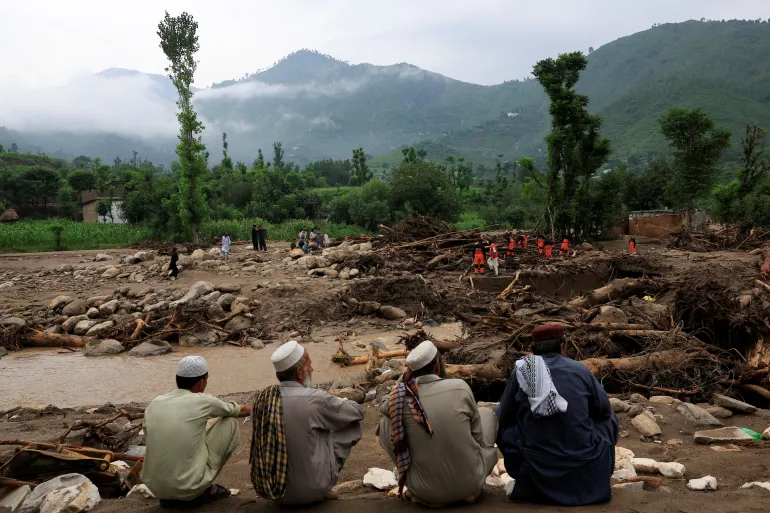
Pakistan floods have left at least 337 people dead and dozens missing after days of torrential rain and cloudbursts devastated northwestern regions. The tragedy has sparked anger among residents, who accuse officials of failing to warn communities in time to evacuate before deadly flash floods and landslides struck.
Rising toll in remote villages
According to the National Disaster Management Authority (NDMA), 337 lives have been lost so far. Rescue teams continue to search for missing people across multiple districts hit hardest by the sudden deluge.
In the remote village of Chositi in Kishtwar district, emergency workers recovered bodies and treated survivors. At least 60 people died, while 150 others were injured. Officials confirmed that nearly 50 of the injured remain in critical condition.
Meanwhile, in Buner, a mountainous district of Khyber Pakhtunkhwa province, torrential rains unleashed torrents of water that swept down from the hills. Mohammad Suhail, a spokesman for the emergency service, said search teams pulled 54 bodies from the debris after hours of digging through mud and collapsed homes. Many residents remain unaccounted for, and authorities fear the death toll will rise.
Floodwaters bring destruction
The sudden floods destroyed houses, roads, and farmland. Survivors described torrents carrying boulders down from the mountains, smashing into homes with the force of explosions. Entire neighborhoods vanished under walls of water, leaving families trapped or washed away.
Emergency crews said recovery efforts are slow because debris continues to block access roads. Some villages can only be reached on foot or by helicopter, making rescue operations difficult.
Impact spreads beyond Pakistan
The devastation has not been confined to Pakistan. In Indian-administered Kashmir, flash floods hit villages in Kathua district. At least seven people died overnight, and five more were injured. Local officials said cloudbursts caused rivers to swell suddenly, leaving villagers little chance to flee.
Both countries face higher-than-normal monsoon rains this year. Since June 26, more than 600 people have died across Pakistan as relentless downpours caused floods, landslides, and infrastructure damage. Meteorologists have warned of more heavy rain through Tuesday, with the risk of additional flooding and landslides.
Read: Punjab Cracks Down on Illegal Hunting with Over 125 FIRs
Residents blame officials
Survivors in Buner openly blamed authorities for failing to provide timely warnings. In many rural areas, mosque loudspeakers are traditionally used to alert people of approaching danger. Residents said this warning system was never activated before the floodwaters struck.
Mohammad Iqbal, a schoolteacher from Pir Baba village, told reporters that the lack of communication cost lives. “Survivors escaped with nothing,” he said. “If people had been informed earlier, lives could have been saved and residents could have moved to safer places.”
Others echoed his frustration, saying the sudden floods forced families to flee in panic, leaving behind homes and possessions. Many survivors now live in makeshift shelters, relying on limited aid.
Government defends its response
In response to criticism, government officials defended their handling of the disaster. Authorities said an early warning system was already in place but admitted the intensity of the downpour in Buner made it impossible to alert residents in time.
Officials explained that the cloudburst was unusually strong and struck within minutes, giving people no chance to react. “The deluge came faster than expected,” a spokesperson said. “We are working with rescue teams to recover those missing and to provide relief to survivors.”
Climate change intensifies risk
Experts warn that Pakistan is increasingly vulnerable to climate change-induced disasters. Warmer temperatures are causing more extreme weather events, including heavier monsoon rains and sudden cloudbursts. These unpredictable downpours overwhelm rivers and mountain valleys, turning them into deadly torrents.
Pakistan has already experienced severe flooding in recent years, with the 2022 floods killing nearly 1,700 people and displacing millions. The current disaster highlights the continuing lack of infrastructure, early warning systems, and disaster preparedness in rural regions.
Call for stronger measures
As emergency operations continue, humanitarian groups are urging the government to improve early warning systems, strengthen infrastructure, and invest in climate adaptation measures. Residents, meanwhile, are calling for accountability and demanding answers as they mourn their dead.
The Pakistan floods have once again exposed the nation’s fragility in the face of climate change. With more rain forecast in the coming days, communities remain on edge, hoping the worst is over but bracing for the possibility of yet another wave of destruction.
Follow us on Instagram, YouTube, Facebook,, X and TikTok for latest updates