Prime Minister Shehbaz Sharif has defended the federal government’s decision regarding Khyber Pakhtunkhwa, saying it was taken in the best interests of the province’s people after negotiations failed to produce a positive response.
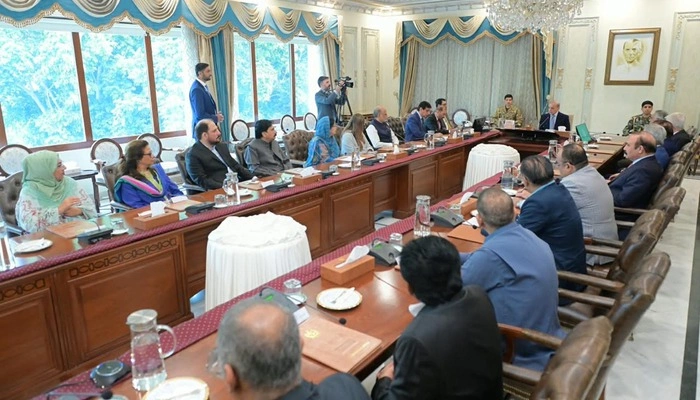
The prime minister made the remarks during a meeting with a delegation of the Muttahida Qaumi Movement-Pakistan (MQM-P), led by Federal Education Minister and party convener Dr Khalid Maqbool Siddiqui, in Islamabad on Tuesday.
According to a statement issued by the Prime Minister’s Office, the meeting discussed the country’s overall political situation, with Sharif briefing the delegation on developments in Khyber Pakhtunkhwa.
The prime minister described the decision as one of the most difficult steps his government had taken, saying it had made extensive efforts to avoid such action.
“We negotiated with an open heart, but received no positive response from the other side,” Sharif said, according to the official statement.
Sharif Criticises Long March Plans
Sharif described the planned long march as an attempt to undermine Pakistan’s improving economic conditions. He argued that political confrontation could disrupt the country’s economic progress at a time when the government was working to stabilise the economy.
The prime minister said the federal government had tried to resolve the differences through negotiations before deciding to take action concerning Khyber Pakhtunkhwa.
He maintained that the government’s decision was guided by the interests and security of the province’s residents.
His comments came amid heightened political tensions surrounding the federal government’s measures concerning the province and disagreements with the Pakistan Tehreek-e-Insaf (PTI).
Security Concerns in Khyber Pakhtunkhwa
The prime minister said increasing terrorist attacks in Khyber Pakhtunkhwa had targeted civilians and security personnel, raising serious concerns about law and order.
He criticised the provincial government for what he described as its failure to speak out clearly against militant groups.
Sharif argued that the deteriorating security situation required effective action and cooperation among political leadership, law enforcement agencies and security institutions.
The province has faced persistent security challenges, including attacks on police and security forces. The federal government has repeatedly stressed the need for stronger coordination to counter terrorism and protect residents.
Sharif said the authorities had attempted to prevent the situation from reaching a point where extraordinary measures became necessary, but the lack of progress in negotiations had left the government with difficult choices.
The prime minister maintained that public safety and stability in Khyber Pakhtunkhwa were central to the decision.
MQM-P Delegation Assures Government of Support
The MQM-P delegation expressed full support for the federal government’s decisions concerning Khyber Pakhtunkhwa, according to the Prime Minister’s Office.
Dr Khalid Maqbool Siddiqui led the delegation, which included Federal Health Minister Syed Mustafa Kamal, Senators Aamir Waliuddin Chishti and Khalida Ateeb, and numerous members of the National Assembly.
Other members included Dr Muhammad Farooq Sattar, Syed Amin-ul-Haque, Khawaja Izhar-ul-Hassan, Ahmed Saleem Siddiqui, and several other parliamentary representatives.
The delegation discussed the prevailing political situation with the prime minister and assured him of its support for the government’s approach.
Senior Government Leaders Attend Meeting
Deputy Prime Minister and Foreign Minister Ishaq Dar, Defence Minister Khawaja Muhammad Asif, Law and Justice Minister Azam Nazeer Tarar, Parliamentary Affairs Minister Dr Tariq Fazal Chaudhry, and Prime Minister’s Adviser on Political Affairs and Interprovincial Coordination Rana Sanaullah also attended the meeting.
The discussions centred on political developments, security challenges in Khyber Pakhtunkhwa and the government’s justification for its recent decisions.
Sharif reiterated that the federal government had pursued negotiations before taking action and maintained that its priority was to protect the interests of Khyber Pakhtunkhwa’s people while preventing further deterioration in security and stability.