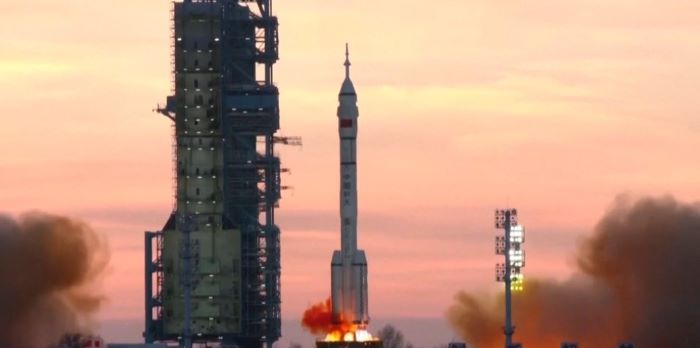
Pakistan’s Muhammad Zeeshan Ali has made history by becoming the first foreign astronaut to join a Chinese crewed space mission after China successfully launched its Shenzhou-24 spacecraft to the Tiangong space station on Wednesday.
The historic mission marks a significant development in Pakistan’s growing space cooperation with China and represents a major achievement for the country’s astronaut programme. Beijing has described the mission as an opportunity to strengthen bilateral relations with Islamabad as both countries celebrate 75 years of cooperation in space exploration.
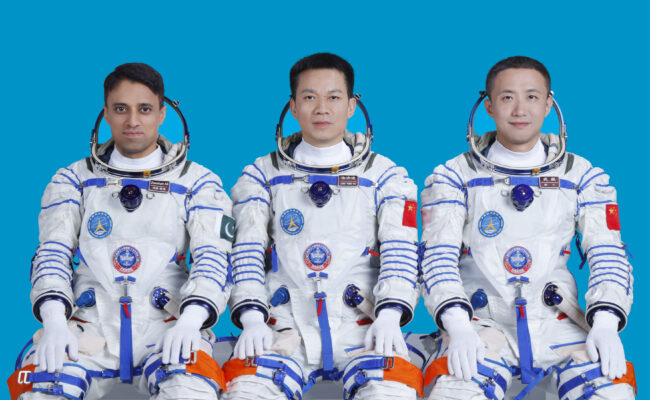
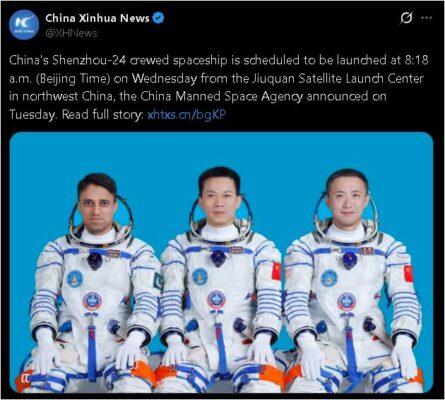
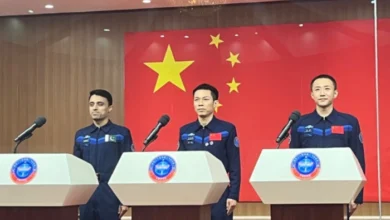
The spacecraft lifted off at 08:18 local time (00:18 GMT) from the Jiuquan Satellite Launch Centre in China’s Gobi Desert. It carried three astronauts, including Pakistani payload specialist Muhammad Zeeshan Ali, Chinese commander Tang Hongbo and flight engineer Wu Yi.

Minutes after liftoff, Chinese space authorities declared the launch a complete success, marking another important step in the country’s ambitious space programme.
Zeeshan Ali Carries Hopes of 250 Million Pakistanis
Speaking to reporters before the launch at the Jiuquan Satellite Launch Centre, Ali expressed pride in representing Pakistan on an international space mission.
Read more: Pakistan’s Zeeshan Ali to Become First Foreign Astronaut to Visit China’s Tiangong Space Station
“I am carrying the name of Pakistan on my shoulder, the hopes of 250 million Pakistanis,” he said.
His participation represents a historic moment for Pakistan, which does not currently operate its own spacecraft capable of sending astronauts into orbit.
Hundreds of people gathered at the launch centre before dawn to witness the occasion. Many waved Pakistani and Chinese flags as the three astronauts appeared in their spacesuits during the farewell ceremony.
Ali’s selection followed a competitive process involving Pakistani candidates who underwent extensive training in China. Khurram Dawood was another candidate who reached the final stage of the selection process.

Both candidates received training in China and gained experience working in Chinese space facilities under the supervision of Chinese experts.
Ali previously served as a fighter pilot, bringing aviation experience to his new responsibilities as a payload specialist. However, learning Chinese was among his biggest challenges during the preparation and training process, according to Pakistani media reports.
Scientific Experiments Planned at Tiangong Space Station
During the mission, the crew will conduct several scientific experiments and test advanced technologies in different research fields, including aerospace medicine, combustion and biological sciences.
One of the major objectives involves examining how the space environment affects living organisms and the human body. Researchers will also investigate the relationship between aging and space conditions, hoping to identify potential approaches to preventing and treating age-related vascular diseases.
Ali will participate in experiments examining photosynthesis in bacteria and studying how radiation and microgravity affect seeds.
Microgravity refers to the condition in which objects appear to experience very weak gravitational effects while in orbit. Studying its impact on biological processes can help scientists understand how plants, microorganisms and human bodies respond to prolonged exposure to space.
The experiments could contribute to future research in medicine, agriculture and long-duration space exploration.
Different Responsibilities for Chinese and Pakistani Astronauts
Unlike his Chinese colleagues, Ali will remain aboard the space station for a relatively short period before returning to Earth.
His return journey will also include two Chinese astronauts who have been living aboard Tiangong since May.
Meanwhile, Tang Hongbo and Wu Yi will begin a six-month stay at the Chinese space station alongside Zhu Yangzhu, a member of the Shenzhou-23 mission, which launched earlier in May.
Zhu has been conducting research into how the human body adapts to extended periods in space.
China typically maintains a three-member crew aboard its space station, with astronauts rotating approximately every six months to support continuous operations and scientific research.
China Seeks Greater International Role in Space Exploration
The mission also carries diplomatic significance for Beijing as China seeks to strengthen its position in the global space industry.
The country has invested billions of dollars in its space programme and developed Tiangong as an independently operated space station. Through international cooperation, Beijing hopes to establish the facility as a platform for scientific research involving other countries rather than limiting its activities to Chinese astronauts and researchers.
China is also pursuing an ambitious goal of landing its astronauts on the Moon for the first time by 2030.
The programme reflects Beijing’s broader ambitions to become a major alternative to the US-led space exploration initiatives and expand its influence in international scientific cooperation.
For Pakistan, the participation of a national astronaut in a Chinese crewed mission opens new opportunities for scientific collaboration, technical training and future space research.
The historic flight also highlights the importance of the longstanding partnership between Islamabad and Beijing, particularly as both countries seek to expand cooperation in advanced technology and scientific development.
Ali’s journey to Tiangong is therefore more than an individual achievement. It represents an important moment for Pakistan’s ambitions in space exploration and its efforts to develop a greater role in the international space community.
-
-
-
-