
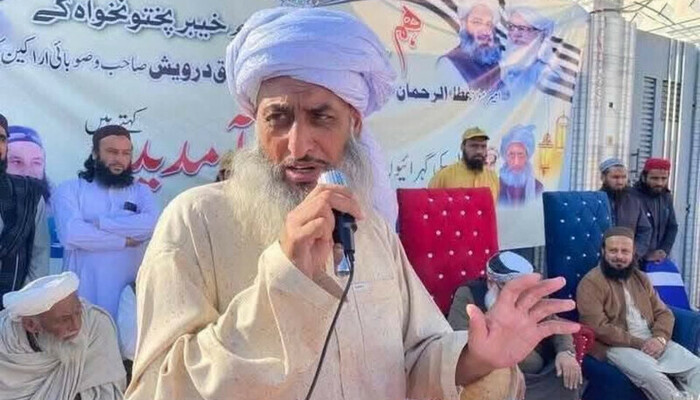
The Malakand shooting shook Khyber Pakhtunkhwa on Saturday when Jamiat Ulema-i-Islam-Fazl’s (JUI-F) district emir, Mufti Kifayatullah, was injured and two others, including his daughter, were killed. The deadly attack targeted his home in Batkhela, sparking a swift response from law enforcement agencies and raising fresh concerns over violence in the region.
Attack at Mufti Kifayatullah’s Home
According to Khyber Pakhtunkhwa police, the incident occurred around 1 p.m. within the limits of Chowki Batkhela, Levies Post Batkhela area. Gunmen opened fire on Mufti Kifayatullah while he was at home with his family. His two daughters were also caught in the gunfire.
One of his daughters died on the spot, while another sustained severe injuries and underwent surgery. The attack also claimed the life of a Levies sepoy, who was on duty at the time. Officials confirmed that Mufti Kifayatullah himself received injuries but survived.
Read: Balochistan Rises Against Terrorism, Says DG ISPR
Immediate Official Confirmation
Malakand Deputy Commissioner and Commandant Levies Hamid Ur Rehman confirmed the details of the shooting. He said law enforcement personnel had quickly cordoned off the area. The police later released an official statement, confirming the casualties and injuries while assuring that investigations were underway.
The statement emphasized that large-scale raids were being carried out across Malakand to track down and arrest the attackers. Authorities pledged to bring the perpetrators to justice and prevent further violence in the district.
Law Enforcement’s Response
The attack triggered a rapid mobilization of Levies forces. Dozens of personnel launched operations in nearby villages to locate the suspects. Local residents reported heavy security activity in Batkhela following the shooting.
Police officials said the investigation was focused on identifying whether the incident stemmed from personal enmity, a targeted assault, or broader militant activity. Initial findings suggested the attackers had prior knowledge of Kifayatullah’s presence at home.
A Pattern of Violence in Malakand
The incident adds to a growing series of violent attacks in Khyber Pakhtunkhwa. Malakand Division, though often considered relatively peaceful compared to other tribal areas, has recently witnessed deadly clashes.
Just last month, at least three people were killed and four others injured when rival groups exchanged fire in Dargai tehsil’s Kharkai area. That attack included women among the injured, highlighting how civilians continue to be drawn into violent disputes.
In June, another attack in Kohat district’s Chashma Ganda area left two dead, including a woman, and 11 injured. Gunmen had opened fire on people returning from a funeral. Police later said the assault was motivated by long-standing personal enmity, a recurring factor in local disputes.
Political and Security Implications
The Malakand shooting targeting a senior JUI-F leader has raised concerns about political figures becoming direct targets. Mufti Kifayatullah is an influential local leader with strong connections to JUI-F’s grassroots base. The attack not only strikes at his family but also sends a message to his supporters.
Security experts warn that such incidents risk destabilizing the fragile peace in Malakand. They also highlight the vulnerability of political leaders in areas where tribal disputes, militancy, and sectarianism intersect.
Community in Shock
Residents of Batkhela expressed shock at the brutality of the attack. Local eyewitnesses described scenes of panic as gunfire erupted near Kifayatullah’s residence. Many residents fled indoors, fearing further violence.
Community elders condemned the attack and called for swift justice. They urged authorities to strengthen security in Malakand to protect both ordinary citizens and political leaders from future assaults.
Wider Context of Violence in KP
Khyber Pakhtunkhwa has long faced challenges from militancy, criminal groups, and personal feuds. While security forces have conducted major operations to curb terrorism, sporadic attacks continue to claim lives.
Observers note that while some incidents stem from personal rivalries, others may be linked to organized groups exploiting local disputes. The blurred lines between personal enmity and targeted militancy make investigations complex.
What Lies Ahead
The Malakand shooting underscores the urgent need for enhanced security measures in the region. With political leaders and civilians both at risk, law enforcement faces mounting pressure to address rising violence.
As Mufti Kifayatullah recovers from his injuries, the killing of his daughter and a Levies sepoy adds to the list of lives lost in Malakand’s cycle of bloodshed. The community now looks to authorities not only for justice but also for lasting peace in a region that has endured too much violence.
Follow us on Instagram, YouTube, Facebook,, X and TikTok for latest updates
