
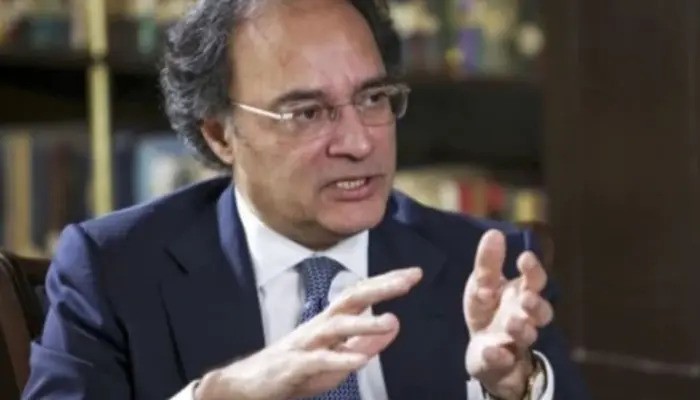
Economic stability remains the top priority as the State Bank of Pakistan (SBP) works actively on the exchange rate and interest rate, according to Finance Minister Muhammad Aurangzeb. He expressed optimism that the country’s financial situation would improve further, with three major global rating agencies already showing a positive outlook for Pakistan.
Job and Education Expo in Karachi
Aurangzeb made these remarks while inaugurating the Job and Education Expo at the Expo Centre in Karachi, organized by the Pakistan Hindu Council. Around 120 stalls were set up by educational institutions and companies to provide opportunities for students and job seekers.
Speaking to the media, he thanked the organizers for creating a platform where he could meet the youth, calling them the future leadership of Pakistan. He noted the strong participation from both public and private institutions but emphasized that the absence of the corporate sector was noticeable.
Technology and Youth Engagement
The minister stressed that technology was the path forward for Pakistan. He urged the youth to commit themselves fully, using both their hearts and minds, while striving for excellence. He highlighted that the nation’s progress depends on young people embracing innovation and working toward sustainable growth.
Read: Gold Prices in Pakistan Extend Downward Trend Amid Decline
Independence Day and Social Inclusion
Referring to the recent Independence Day celebrations of the “Marka-e-Haq,” Aurangzeb said people from all religions participated with great spirit. He underscored the importance of unity, noting that diversity strengthens the nation’s resolve.
Interest Rate and Capital Market Development
Aurangzeb clarified that setting interest rates remains solely within the mandate of the SBP, not the government. He said Pakistan must avoid focusing on interest rates alone as the single-point agenda. Instead, the country needs to broaden its financial base by including capital markets alongside banks.
He suggested shifting the debt capital market to the Pakistan Stock Exchange mechanism to enhance efficiency and attract more investment. According to him, such reforms would strengthen working capital flows and reduce reliance on banks alone.
Addressing Circular Debt
The finance minister provided an update on the energy sector, saying circular debt in power was already declining. He announced that three distribution companies (DISCOs) were in line for privatization soon. The government, he added, was also addressing circular debt in the gas sector, which has long burdened the economy.
Effective Use of Available Funding
Aurangzeb noted that Pakistan already has sufficient funding resources, but the challenge lies in their effective utilization. He emphasized that the exchange rate would continue to be determined by the market, not by administrative controls. This, he said, would ensure transparency and build investor confidence.
Women’s Participation and Poverty Reduction
Highlighting the role of women in economic development, the minister said their active participation could become a driving force in reducing poverty. He praised Mustafa Kamal’s efforts in promoting population control and confirmed that discussions with the World Bank had already taken place to support such initiatives.
IMF Programme and Long-Term Goals
Aurangzeb shared that the IMF review mission would soon visit Pakistan under the ongoing 37-month programme. The government, he said, remains in constant contact with the Fund. Looking to the future, he expressed optimism that Pakistan would reach the level of a developed economy by 2047 if reforms continued.
He also pointed out that Pakistan’s strong anti–money laundering laws had played a key role in securing the country’s removal from the FATF grey list. He expressed confidence that Pakistan would remain compliant and stay off the list.
Responding to Challenges
When asked about recent flood damage in Khyber Pakhtunkhwa, Aurangzeb said his immediate focus was relief and rehabilitation. It was too early, he added, to estimate the financial losses. On the issue of traders’ demand for a new province, he avoided giving a direct response, choosing instead to stress broader national priorities.
Moving Toward Sustainable Growth
Aurangzeb reminded the audience that economic growth does not come from shortcuts. Instead, the government’s role is to create an enabling environment. Public-private partnerships are already delivering results, he said, and the country must now prepare to move into the era of artificial intelligence.
He concluded by stressing that while ups and downs are natural in any economy, talent remains constant. With stability achieved, Pakistan is now in a stronger position to move forward.
Follow us on Instagram, YouTube, Facebook,, X and TikTok for latest updates
