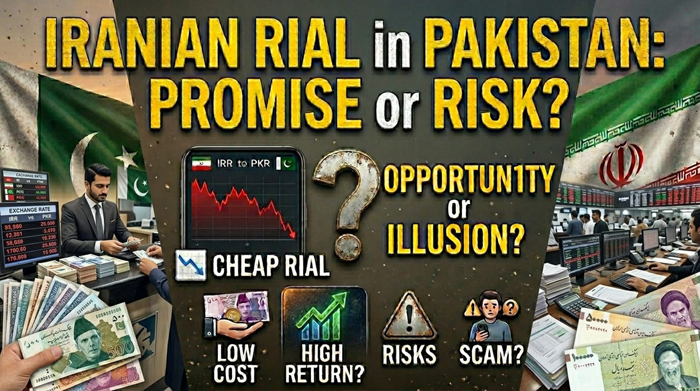
Iranian Currency Investment is trending across Pakistan, a new financial trend is gaining momentum. From YouTube vlogs to WhatsApp groups, thousands of people are being encouraged to invest in the Iranian currency, known as the rial. The promise is simple and seductive: buy now at extremely low rates and become a millionaire when the value rises.
But behind this growing excitement lies a critical question. Is Iranian currency investment in Pakistan a genuine opportunity, or is it the country’s next major financial gamble?
Read More: Iran Rial Hits Historic Low After Europe Moves to Reimpose
How the Trend Started
The surge in interest began during recent geopolitical tensions involving Iran. As conflict escalated, conventional wisdom suggested that Iran’s currency would collapse further. Surprisingly, short-term fluctuations showed a sharp increase in the rial’s value against the Pakistani rupee in informal markets.
Before the crisis, one crore Iranian rials were worth around PKR 2,500. Within weeks, the same amount reportedly rose to nearly PKR 10,000 in certain trading circles. This fourfold increase triggered widespread attention.
Social media quickly amplified the narrative. Influencers and vloggers presented the rial as a hidden opportunity, comparing it to early-stage cryptocurrency investments. The message was clear: invest small today and gain massive returns tomorrow.
Why Are Pakistanis Buying Iranian Currency?
There are three major reasons behind the rising trend of Iranian currency investment in Pakistan.
First, there is hope. Many believe that if international sanctions on Iran are lifted and diplomatic relations improve, the rial could strengthen significantly. This expectation is driving speculative buying.
Second, cross-border trade between Pakistan and Iran is increasing. Transactions involving petroleum products and essential goods are sometimes conducted in local currencies, including the rial. This creates a limited but real demand.
Third, geopolitical developments such as strategic control over key trade routes have fueled speculation that Iran may push for regional transactions in its own currency, potentially increasing demand.
While these factors provide some logic, they do not guarantee long-term stability.
The Hidden Risks of Iranian Currency Investment in Pakistan
Despite the hype, financial experts warn that the risks are substantial.
The first and most critical risk is limited global acceptance. The Iranian rial is not widely traded in international markets and is largely excluded from global banking systems. This makes it extremely difficult to convert into major currencies.
Second, there is a growing concern about counterfeit currency. Unregulated markets increase the chances of fraud, especially for inexperienced buyers.
Third, historical data paints a worrying picture. Over the past decade, the rial has lost more than 90 percent of its value against stronger currencies. Even in 2026, it has experienced extreme volatility, including sharp declines.
Fourth, geopolitical uncertainty remains high. Continued sanctions, political instability, or prolonged conflict could push the currency even lower.
Finally, there is no legal protection. Unlike regulated investments, buying foreign currency through informal channels offers little to no recourse in case of fraud or loss.
Understanding the Numbers
To simplify the situation, consider the current valuation. One Pakistani rupee can fetch thousands of Iranian rials, while one rial is worth only a fraction of a rupee. This means even large quantities of rial represent minimal real value.
However, short-term gains have been possible. Those who entered the market early during fluctuations did see temporary profits. The key issue is sustainability, not short-term spikes.
Should You Invest?
The decision depends entirely on your risk tolerance.
If you are involved in legitimate cross-border trade with Iran, holding rial may be practical. However, if your goal is speculative profit, caution is essential.
Only invest an amount you can afford to lose. Avoid deals from unknown sources or guaranteed return schemes. Always verify exchange rates and deal only with recognized currency dealers.
Read More: Iran Rial Surge in Pakistan
Final Verdict
Iranian currency investment in Pakistan may appear to be a golden opportunity, but it carries significant uncertainty. While short-term gains have attracted attention, the long-term outlook remains unclear.
History shows that when a financial trend becomes widely popular on social media, it is often time to be cautious rather than excited.
Be informed, stay realistic, and remember that not every cheap asset is a valuable investment.