
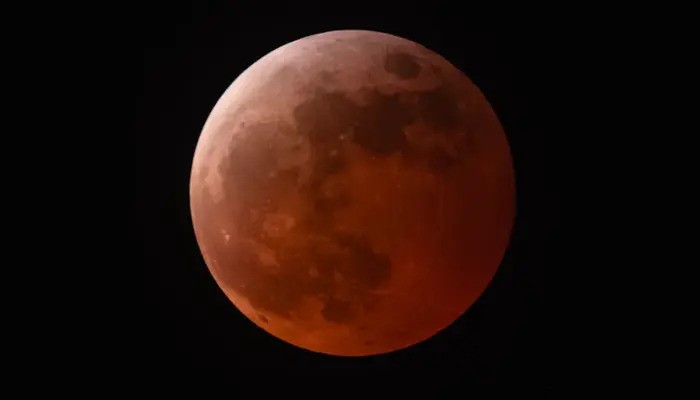
The much-awaited blood moon will light up the night sky on September 7-8 as a total lunar eclipse unfolds, turning Earth’s natural satellite into a glowing red spectacle. Stargazers across many regions are preparing to witness this breathtaking celestial event that only occurs a few times each year.
What is a Total Lunar Eclipse?
A total lunar eclipse takes place when Earth moves directly between the sun and the moon. This alignment blocks direct sunlight from striking the lunar surface. Instead, sunlight bends through Earth’s atmosphere before reaching the moon.
The unique tilt of the moon’s orbit prevents a total eclipse from happening every month. But a few times each year, the sun, Earth, and moon line up perfectly. When this occurs, the result is a stunning lunar display that excites both astronomers and casual skywatchers.
Why the Moon Turns Red
During totality, the moon takes on a rusty or crimson glow. This transformation happens because of Rayleigh scattering, the same process that makes sunsets appear red. As sunlight filters through Earth’s atmosphere, shorter blue wavelengths scatter out, while longer red wavelengths pass through.
This filtered light bathes the moon, painting it with shades ranging from deep orange to dark red. That is why the total lunar eclipse is often called the “blood moon.”
The Path to Totality
The eclipse will move through several distinct phases. First, the moon will enter Earth’s outer shadow, known as the penumbra. At this stage, the dimming will be subtle. As the moon slips into the darker inner shadow, the umbra, the transformation becomes striking.
Totality occurs when the moon is completely within the umbra. At that moment, the lunar disk will shine in vivid red against the backdrop of a dark sky. After totality ends, the moon will slowly move back out of the shadows, returning to its familiar silver glow.
A Global Celestial Event
Not everyone will have the same viewing opportunity. Visibility will depend on location and weather conditions. For some regions, the entire eclipse will be visible, while others may only see partial phases.
For those under cloudy skies or where the moon sets early, online streams will make the event accessible. Dedicated platforms will provide live coverage, allowing people everywhere to witness the phases unfold in real time.
Read: Hideo Kojima’s Unconventional Approach to Game Design
The Best Time to Watch
The nights leading up to September 7 are ideal for planning. Choosing an open spot with a clear horizon ensures an uninterrupted view. Parks, fields, or elevated areas often make the best locations.
Photographers are especially encouraged to prepare in advance. By scouting locations early, they can frame the eclipsed moon with landmarks, trees, or city skylines for dramatic compositions. The extra preparation also helps avoid last-minute disruptions such as obstructing buildings or poor sightlines.
A Treat for Stargazers
For casual observers, no special equipment is necessary. The blood moon can be enjoyed with the naked eye. However, binoculars or small telescopes can enhance the details, revealing subtle textures on the moon’s surface even during totality.
The color of the moon may vary depending on atmospheric conditions. Dust, smoke, or volcanic particles in the air can intensify the red tones. This unpredictability adds a layer of excitement to every lunar eclipse.
The Science Behind the Beauty
Lunar eclipses are more than just visual wonders. They provide scientists with valuable opportunities. By studying the light that filters through Earth’s atmosphere during the eclipse, researchers can learn more about atmospheric composition, dust content, and global weather patterns.
Such observations also help astronomers refine models of how Earth’s atmosphere scatters light. These insights can even be applied to studying the atmospheres of distant exoplanets.
Rare but Predictable
While not monthly events, total lunar eclipses follow a predictable cycle. Astronomers can forecast them centuries in advance with precision. In 2025, multiple eclipses are scheduled, but the September blood moon promises to be among the most striking.
These events remind people of the rhythms of celestial mechanics, where cosmic alignments produce awe-inspiring sights visible from Earth’s surface.
A Night to Remember
As September 7-8 approaches, excitement is building among skywatchers worldwide. The blood moon total lunar eclipse offers a chance to connect with the cosmos in a vivid, unforgettable way. Whether seen from a telescope, a camera lens, or with the naked eye, the sight of Earth’s shadow painting the moon red is an experience that lingers in memory long after the night ends.
This event is not only a reminder of our planet’s place in the solar system but also a symbol of nature’s ability to inspire awe and wonder. For seasoned astronomers and casual stargazers alike, the coming blood moon promises a show that cannot be missed.
Follow us on Instagram, YouTube, Facebook,, X and TikTok for latest updates
