
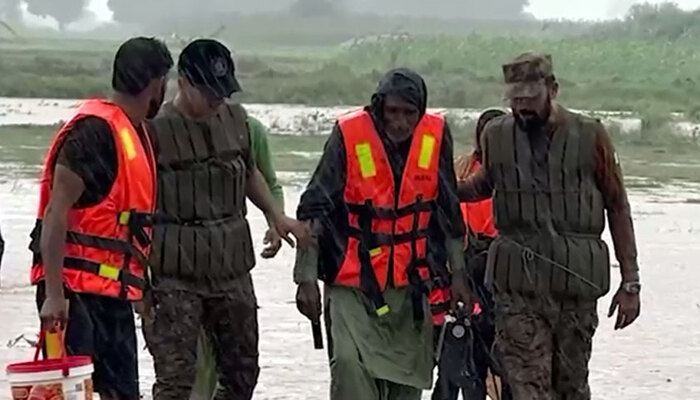
The Pakistan Army rescue operations are in full swing across the Faisalabad Division as heavy floods continue to displace thousands. Soldiers are working around the clock in Jhang, Faisalabad, Chiniot, and Toba Tek Singh to protect lives and provide urgent relief. From breaching embankments to setting up camps, the Army has taken swift measures to shield vulnerable communities from disaster.
Immediate Action to Protect Lives
Floodwaters threatened to engulf entire settlements in Jhang and Faisalabad. To divert the water safely, Army engineers deliberately breached embankments at three different locations. This calculated move redirected between 100,000 and 150,000 cusecs of water downstream, easing the immediate threat to densely populated areas.
Residents praised the Army’s quick response, noting that timely intervention prevented further loss of life and property. By sacrificing farmlands and open spaces, the Army ensured that towns and villages remained secure.
Evacuations Through Air and Water
As floodwaters rose, Army units launched large-scale evacuations. Helicopters hovered over submerged areas, airlifting families trapped on rooftops. At the same time, boats ferried stranded villagers to higher ground. Soldiers worked in challenging conditions, navigating strong currents and heavy rain to rescue families, children, and the elderly.
Those rescued expressed relief and gratitude. Many said they had lost their homes but were thankful to be alive. The Army pledged to continue evacuations until every stranded person was safely relocated.
Read: Pakistan Secures Four-Year US Approval for Seafood Exports
Relief Camps for Flood Victims
In Tandlianwala Tehsil, authorities with Army support established five relief camps, 18 medical camps, and six rescue camps. These facilities now serve as lifelines for displaced people who lost shelter to the flood.
At the relief camps, Army personnel distribute food, water, and bedding. Families find temporary safety under tents, while children receive meals and care. Volunteers also join hands with soldiers, ensuring no victim is left unattended.
Essential Medical Assistance
Medical teams play a central role in the Pakistan Army rescue operations. In the established medical camps, Army doctors and paramedics provide essential treatment to flood victims. They treat waterborne diseases, injuries, and infections that often spread in disaster zones.
Free medicines are available at all centers. Pregnant women and elderly patients receive priority care. Doctors remain on call around the clock, ensuring emergencies receive immediate attention. By offering both treatment and preventive measures, the Army has reduced the risk of outbreaks.
Coordination With Civil Authorities
The Army is not working in isolation. Local administrations and civil defense forces coordinate closely with Army units. Together, they map out flood-affected zones, identify weak embankments, and plan joint rescue missions.
This coordination ensures resources are used efficiently. Relief supplies reach the most affected areas first, while medical support follows evacuations. Such teamwork has created a systematic response that avoids duplication and delay.
Challenges on the Ground
Despite progress, challenges remain. Rising waters continue to threaten low-lying villages. Many roads are submerged, cutting off access to remote communities. Strong river currents make boat operations risky, while helicopters face visibility issues in heavy rain.
Army officers acknowledge these difficulties but stress that operations will not stop. Soldiers rotate shifts to maintain energy, while equipment and vehicles are moved strategically to avoid delays. Every decision, they emphasize, is focused on saving lives.
Community Resilience and Support
Alongside Army efforts, local communities have shown resilience. Volunteers assist in distributing food and guiding families to camps. Many farmers, though losing their crops, allow their lands to be used as safe routes for rescue operations.
Stories of bravery emerge daily. Villagers help soldiers in evacuations, while youth groups carry supplies to those unable to walk. These efforts strengthen the Army’s work and build a spirit of unity in the face of disaster.
The Human Impact of Floods
The floods have forced thousands from their homes. Families live in temporary shelters, unsure of when they can return. Children face disruption to education, while parents worry about rebuilding their livelihoods.
The Army acknowledges these struggles. Officers emphasize that rescue is only the first step. Long-term rehabilitation will require rebuilding homes, repairing schools, and restoring health services. Relief operations now focus on survival, but the path to recovery will extend far beyond the floodwaters.
A Promise of Continued Support
The Pakistan Army rescue operations in Faisalabad Division highlight the institution’s role in times of crisis. From breaching embankments to setting up medical camps, the Army has demonstrated both efficiency and compassion.
Officials assure that operations will continue until all victims are safe. More resources, including boats and medical teams, are being mobilized. Relief camps will remain operational until floodwaters recede and families can return to their homes.
Moving Toward Recovery
For now, survival remains the priority. Yet the actions taken in these critical days will shape the road to recovery. The Army’s presence has given victims hope, ensuring that even in the worst of times, help is at hand.
As soldiers continue their mission across Jhang, Faisalabad, Chiniot, and Toba Tek Singh, the people of the region find strength in knowing they are not alone. In every helicopter rescue, every boat mission, and every medical camp, the spirit of service stands strong.
Follow us on Instagram, YouTube, Facebook,, X and TikTok for latest updates
