
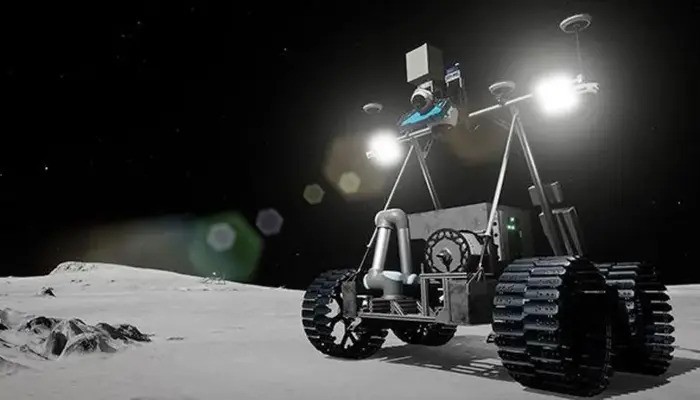
Canada’s first lunar rover marks a historic leap in space exploration. The rover, built by Canadensys Aerospace, will search for water and study the Moon’s surface under NASA’s Artemis program. This lunar rover not only highlights Canadian innovation but also represents the country’s bold step into planetary exploration.
A Historic First for Canada
For decades, Canada has contributed to space exploration through satellites, robotic arms, and astronauts. Yet this rover stands out as the first Canadian-built vehicle designed for planetary surface exploration. Scheduled for launch in 2029, it will travel to the Moon’s south pole, one of the most hostile and scientifically valuable regions.
The Vision Behind the Mission
Canadensys Aerospace, a Toronto-area company, leads the project. Its president, Dr. Christian Sallaberger, calls the rover part of a bigger plan to help “move humanity off Earth.” According to him, learning about the Moon is the logical first step. It can serve as a base for longer missions, including those to Mars.
“Science fiction excites people with ideas of new worlds,” Sallaberger said. “This rover is making those ideas real.”
Part of NASA’s Artemis Program
The rover joins NASA’s Artemis program, which aims to establish a lasting human presence on the Moon. Its tasks include searching for water ice, measuring radiation, and testing how technology can survive extreme lunar nights. Each night lasts about 14 Earth days, with temperatures plunging to –200°C before soaring to 100°C in the daytime.
Read: Google Earth Day Quiz: Test Your Knowledge of Our Planet
Surviving these swings is one of the mission’s greatest engineering challenges. Canadensys engineers are designing and testing prototypes to make sure the final rover withstands these conditions.
Building on a Strong Space Legacy
Canada has a strong record in space achievements. It became the third nation to launch a satellite, designed the famous Canadarm for NASA, and contributed to the International Space Station. Astronauts like Chris Hadfield inspired global audiences, while Jeremy Hansen will orbit the Moon on Artemis II. This rover builds on that legacy by showcasing Canadian engineering on a new frontier.
A Rover Designed for Harsh Terrain
The 35-kilogram rover is small but highly specialized. Its wheels must endure the Moon’s regolith, a jagged, sticky layer of dust and rock fragments. Unlike rounded Earth soil, lunar dirt clings to machinery like Velcro. Engineers at Canadensys test wheel designs to avoid jamming and damage.
Temperature is another obstacle. Sallaberger explained that the real challenge is not only surviving the extreme cold but also coping with rapid swings between freezing and boiling conditions. Every component must prove it can handle the Moon’s extremes before final assembly.
The Search for Lunar Water
Water on the Moon could change the future of exploration. For years, scientists thought the Moon was dry, based on Apollo missions. That view shifted in 2008 when reanalysis of Apollo samples showed traces of water, and spacecraft detected more evidence from orbit.
Dr. Gordon Osinski, the mission’s chief scientist from Western University, explained the importance of this search. “Is it ice scattered like grains in the soil, or frozen sheets like a hockey rink? We don’t know yet.”
If the rover confirms usable water, it could provide drinking supplies, fuel production, and life-support systems. Splitting water molecules produces hydrogen for rocket fuel, making the Moon a potential refueling station for deep-space missions.
Engineering and Testing the Rover
Prototypes of the rover are already in development at Canadensys headquarters. Engineers test parts in labs designed to simulate lunar conditions. The final rover will be built only after all components prove reliable.
The mission received C$4.7 million in government funding in 2022, giving Canadensys resources to push forward. The company, founded in 2013, has worked with NASA, the Canadian Space Agency, and private firms. More than 20 Canadensys instruments have already flown on lunar and planetary missions.
Risks and Setbacks in Space Exploration
Even with careful preparation, success is never guaranteed. Recent attempts by private companies highlight the risks. In 2025, a US-built lander tipped over upon arrival, while a Japanese craft lost contact and failed. Sallaberger acknowledges these challenges but emphasizes resilience. “Things do go wrong,” he said. “We focus on minimizing the risks.”
Global Cooperation and Competition
Space exploration remains both a cooperative and competitive field. The International Space Station proved how rivals could work together. But as countries eye the Moon’s resources, questions about ownership grow. Laws like the US measure protecting Apollo landing sites reflect these concerns.
Still, the Artemis Accords offer hope. Over 50 countries, including smaller nations, have signed on to principles of sustainable and peaceful exploration. This agreement shows that Moon exploration can unite nations rather than divide them.
Looking Beyond the Rover
The rover is just the start. Canadensys also envisions lunar greenhouses and other systems for long-term living on the Moon. Sallaberger sees this as preparation for Mars and beyond. “If you can design something to survive on the Moon,” he said, “you’re ready for almost anywhere in the solar system.”
A Bold New Chapter
Canada’s first lunar rover represents more than a machine. It symbolizes a nation stepping into a larger role in humanity’s push into space. By tackling the Moon’s harsh environment, searching for water, and proving its technology, Canada positions itself at the forefront of planetary exploration. The journey may begin with a small rover, but its impact could be as vast as space itself.
Follow us on Instagram, YouTube, Facebook,, X and TikTok for latest updates
