
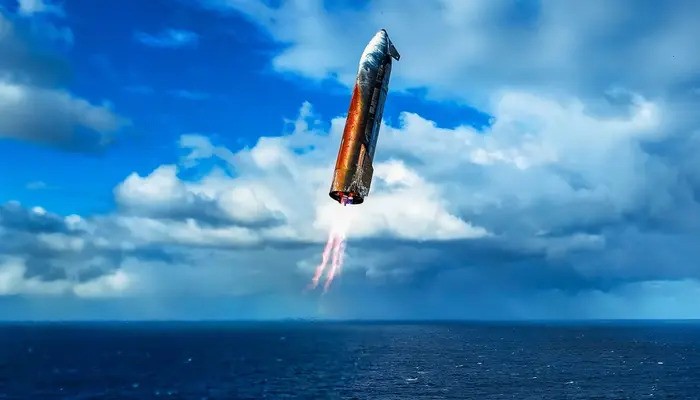
Elon Musk says Starship reusability is on the verge of becoming reality. Speaking at the All-In Summit on September 9, the SpaceX chief expressed confidence that the company will deliver 100 tons of payload to orbit next year using a fully reusable Starship system. Both the Super Heavy booster and the upper stage will be recovered and reused, marking a milestone in spaceflight.
Musk Confident in Version 3
Musk revealed that the upcoming version 3 of Starship will be a “gigantic upgrade” over the current version 2. The new model will feature third-generation Raptor engines and sweeping design changes across the rocket.
“Unless we face very major setbacks, SpaceX will demonstrate full reusability next year,” Musk said. He emphasized that both stages would be caught and reused, while delivering more than 100 tons into a useful orbit.
The leap in performance is critical for SpaceX. It will enable the company to deploy larger next-generation Starlink satellites and support the NASA Artemis lunar missions with Starship’s lander variant.
Final Version 2 Flight Planned
Before the transition to version 3, SpaceX will launch one more version 2 Starship later this year. Musk confirmed that this last mission will be suborbital, focused on collecting data.
Bill Gerstenmaier, SpaceX vice president of build and flight reliability, echoed this view at the Glenn Space Technology Symposium on September 8. He said the company wants to better understand how the ship performs during flight.
Gerstenmaier noted that the first version 3 mission will likely also be suborbital. If successful, an orbital attempt could follow with the very next launch.
Read: Apple Unveils iPhone Air as Part of iPhone 17 Lineup
Overcoming Early Failures
The path to this milestone has not been smooth. Earlier this year, three consecutive Starship flights ended in mission-ending failures. However, SpaceX achieved a largely successful mission with Flight 10 on August 26, bringing the program back on track.
Musk acknowledged that version 3 may face “teething pains” due to its radical redesign. Still, he remains confident that the engineering improvements will make Starship far more capable and reliable.
Heat Shield Challenges
One of the toughest obstacles to Starship reusability is creating a heat shield that can withstand orbital reentry. Unlike the space shuttle, which required extensive heat shield maintenance, SpaceX aims to build a system that needs little to no refurbishment between flights.
“No one has ever made a fully reusable orbital heat shield,” Musk said. He explained that the shield must survive extreme heat, remain lightweight, and stay attached to the vehicle without cracking.
Testing Thermal Protection
Flight 10 gave SpaceX valuable insights into the performance of different heat shield materials. Engineers experimented with ceramic tiles, metallic tiles, and ablative materials.
The metallic tiles oxidized during reentry and failed to perform as hoped. The white discoloration seen on the nose section came from ablative material beneath the tiles, showing that heat was seeping through gaps.
To address this, SpaceX tested a technique called “crunch wrap.” This method involves wrapping each tile in a protective layer before installation. Tiles with crunch wrap showed better sealing and reduced ablation underneath.
Preparing for the Next Flight
Gerstenmaier said that future flights will make greater use of the crunch wrap method. “We’re going to try to seal between the tiles without adding separate gap fillers,” he explained. The next flight will rely less on thermal experiments and move closer to the configuration SpaceX plans to use for operational missions in 2026.
This step marks a shift from experimentation to refinement, as the company prepares for fully reusable operations.
Why Starship Reusability Matters
Achieving Starship reusability will redefine the economics of space exploration. A rocket that can carry over 100 tons to orbit while being rapidly reused would slash launch costs and open the door to larger projects.
For SpaceX, this capability is essential for expanding Starlink coverage with more powerful satellites. It is also critical for NASA’s Artemis program, where Starship will serve as a lunar lander to transport astronauts to the Moon’s surface.
In the longer term, Musk envisions Starship as the vehicle that will carry humans to Mars. Reliable reusability is a prerequisite for making such interplanetary missions affordable and sustainable.
Follow us on Instagram, YouTube, Facebook,, X and TikTok for latest updates
