
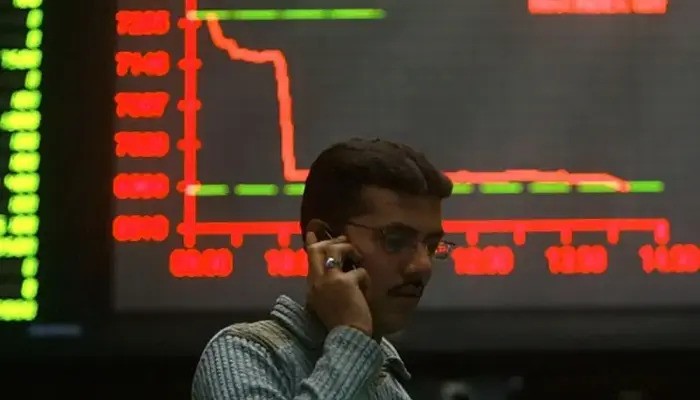
The KSE-100 index faced a major setback on Friday as the Pakistan Stock Exchange (PSX) recorded its second consecutive losing session. Selling pressure intensified throughout the day, driving the benchmark index down by more than 1,700 points and reversing early gains.
Early Optimism Fades
The session began with cautious optimism. The index briefly climbed to an intra-day high of 156,519.14 on the back of selective buying. However, the momentum quickly reversed when sellers dominated the market in the latter half of the session.
By the closing bell, the KSE-100 had slipped into negative territory, settling at 154,439.68. This marked a fall of 1,701.56 points, or 1.09%, compared to the previous day.
Analysts Cite Rising Leverage Costs
Market analysts attributed the decline to the rising cost of leverage in both the Margin Trading System (MTS) and futures market. A post-market report by Topline Securities noted, “Correction was observed due to increasing borrowing costs, with the index declining by -1.09%.”
Major contributors to the downturn included blue-chip stocks such as United Bank Limited (UBL), Fauji Fertilizer Company (FFC), Engro Corporation (ENGROH), Hub Power Company (HUBC), and Lucky Cement (LUCK). Collectively, these five companies pulled down the index by nearly 900 points.
Read: US Dollar Hits Record ₹88.43 Against Indian Rupee
Profit-Taking Extends into Second Day
Friday’s loss followed Thursday’s session, when profit-taking had already pressured the index into negative territory after several days of bullish momentum. Despite this back-to-back decline, the KSE-100 still managed to wrap up the week on a nearly flat note.
According to Ali Najib, Deputy Head of Trading at Arif Habib Ltd, the index gained 163 points across the week. “Despite surrendering early-week gains, the KSE-100 navigated a wide range, slipping to 154,360 at its low and scaling a record 157,817 at its high before ultimately closing at 154,440,” Najib said.
He added that while volatility will likely persist, the 154,000 level continues to serve as a strong support zone for the market.
Global Markets Boosted by Rate Cut Prospects
In contrast to the local downturn, international markets saw a positive run on Friday. Asian shares tracked Wall Street higher as investors bet on several U.S. interest rate cuts in the coming months.
Indexes in Japan, South Korea, and Taiwan all scaled record highs, spurred by optimism over artificial intelligence-driven earnings growth. Japan’s Nikkei rose 0.6% to another all-time high, posting a weekly gain of 3.7%. South Korea surged 1.1%, pushing its weekly rise beyond 5%.
Meanwhile, Chinese blue-chip stocks edged up 0.2%, reaching their highest levels since early 2022. MSCI’s broadest index of Asia-Pacific shares outside Japan jumped 1.2%.
US Data Clears Way for Federal Reserve Move
A crucial factor behind the global rally was the release of the U.S. consumer price report. The data, seen as the last major hurdle before the Federal Reserve’s September meeting, appeared soft enough to support a rate cut.
Citi analysts forecasted the Fed’s preferred inflation gauge, the core personal consumption expenditures (PCE), would hold steady at 2.9% for August. Markets now imply a 100% chance of a quarter-point rate cut to 4.00%-4.25% next week. The probability of two additional cuts this year has climbed to nearly 90%.
U.S. Treasury yields reflected these expectations, with the 10-year yield falling by 20 basis points over the past two weeks. The decline is already easing borrowing costs tied to mortgage rates, offering relief to bond markets in both the U.S. and Europe.
Rupee Maintains Positive Streak
On the currency front, the Pakistani rupee continued its upward momentum against the U.S. dollar. In the inter-bank market, the rupee closed at 281.55, marking a modest gain of Re0.01.
This move extended the rupee’s winning streak to 26 consecutive sessions, providing some stability for importers and easing inflationary pressures in the short term.
Trading Activity Slows
Trading volumes fell sharply compared to the previous day. The all-share index recorded 987.59 million shares traded, down from 1.27 billion a day earlier. Similarly, the value of shares traded decreased to Rs39.91 billion from Rs50.21 billion.
Among individual stocks, F. Nat. Equities led the volume chart with 61.99 million shares. Agha Steel Industries followed with 61.30 million shares, while Pervez Ahmed Co secured third place with 47.22 million shares.
Out of 476 companies that traded, 180 posted gains, 263 declined, and 33 remained unchanged.
A Market Balancing Local and Global Forces
The KSE-100 index’s decline underscores the fragile balance between local pressures and global trends. Rising leverage costs and profit-taking have weighed heavily on the market, but global optimism over U.S. rate cuts and strong performances in Asian markets provide a contrasting backdrop.
Investors remain cautious, watching whether the index can hold its support at 154,000 while awaiting clarity on both domestic economic conditions and global financial developments.
Follow us on Instagram, YouTube, Facebook,, X and TikTok for latest updates
