
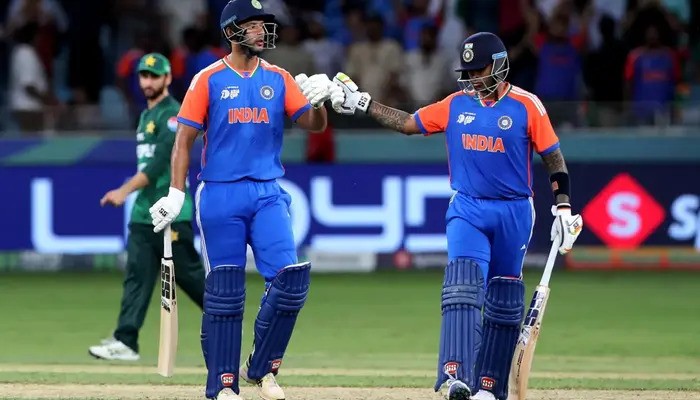
The Pakistan vs India clash in the Asia Cup 2025 turned out to be a one-sided affair as India cruised to a comfortable seven-wicket win in Dubai on Sunday. Pakistan faltered with the bat, managing only 127-9, while India chased the target with ease, sealing victory with more than four overs to spare. The contest, already politically charged, ended on a bitter note with both teams refusing to shake hands.
Tense Build-Up and Political Undertones
This match carried extra weight beyond cricket. Calls for a boycott had dominated the Indian media in the lead-up, and the tension spilled onto the field. At the toss and after the game, Indian players refused to shake hands with their Pakistani counterparts.
Indian captain Suryakumar Yadav added fuel to the fire in his post-match speech. He dedicated the win to victims of the Pahalgam terror attack, which sparked a four-day military clash between the two countries earlier this year. “We stand with the victims’ families and dedicate this win to the armed forces,” he declared, framing the match as more than just sport.
Pakistan’s captain Salman Ali Agha skipped the post-match ceremony. Head coach Mike Hesson later explained that the team was disappointed with India’s conduct. He noted that Pakistan had wanted to shake hands, but India refused, leading to visible friction.
Pakistan’s Struggles with the Bat
Sent in to bat first, Pakistan had a disastrous start. Saim Ayub fell on the very first ball, repeating his struggles from previous games. Haris soon followed, edging a sharp delivery from Bumrah. Fakhar Zaman survived an early lbw scare but could not last long, falling to Axar Patel after trying to hit his way out of pressure.
The middle order crumbled against India’s spinners. Varun Chakravarthy and Axar Patel tied down the run rate, while Kuldeep Yadav was the standout performer. His figures of 3-19 dismantled Pakistan’s batting momentum.
Salman Ali Agha failed to anchor the innings, dismissed while attempting to accelerate. Hasan Nawaz and Mohammad Nawaz fell in consecutive deliveries, leaving Pakistan in deep trouble at 64-6.
Read: India vs Pakistan Asia Cup Clash Faces Rare Ticket Snub
Shaheen Afridi’s Late Resistance
With the top order gone, Pakistan relied on tailenders to push the score. Sahibzada Farhan managed a scratchy 40, but it was Shaheen Afridi who injected late energy. Walking in at number nine, he smashed four towering sixes, including two in the final over against Hardik Pandya.
Shaheen’s cameo lifted Pakistan to 127-9, a total that at least gave the bowlers something to defend. However, it was far below par on a surface that offered little help to either pace or spin.
Indian Bowlers Dominate
India’s bowlers executed their plans with precision. Kuldeep’s wrist spin consistently deceived the Pakistani batters, while Patel kept a tight line. Jasprit Bumrah’s fiery opening spell removed Haris and set the tone. Hardik Pandya contributed with early control, while Varun Chakravarthy’s variations ensured Pakistan never settled.
The bowlers worked as a unit, forcing 55 dot balls across the innings. By the end, Pakistan looked clueless against both pace and spin.
India’s Calm Chase
Chasing 128 was never going to be daunting for India, but they did face early setbacks. Shubman Gill departed after a quick start, and Abhishek Sharma followed after hitting a couple of boundaries. Saim Ayub, despite his batting failure, made amends with the ball by dismissing both openers.
Still, India never looked in real trouble. Tilak Varma and captain Suryakumar Yadav steadied the innings with a composed partnership. Yadav, in particular, grew more aggressive as the target neared, cutting and pulling Pakistan’s spinners for boundaries.
Suryakumar Yadav Leads the Way
Yadav played with authority, finishing unbeaten and posting his highest T20I score against Pakistan. He survived a close lbw review but continued to dominate. His six to finish the match underlined India’s control throughout the chase. Shivam Dube supported him with a brief cameo, including a massive six to speed up the finish.
India reached 131-3 in just the 16th over, sealing a comprehensive win and cementing their dominance in the Asia Cup group stage.
Pakistan’s Missed Opportunities
Pakistan’s bowlers could not replicate the discipline shown by their Indian counterparts. Despite Saim Ayub’s three wickets, the attack lacked consistency. Abrar Ahmed and Mohammad Nawaz kept things tight at times but failed to create breakthroughs when needed.
The team’s body language reflected frustration, especially after India’s refusal to engage in post-match courtesies. Head coach Mike Hesson admitted that the conduct of the opposition had unsettled the players.
Beyond the Game
This fixture once again highlighted how cricket between Pakistan and India carries weight far beyond the field. With political tensions still raw after recent border clashes, the Asia Cup match became a stage for national statements.
India’s win, dedicated to victims of terrorism, was framed as symbolic. Pakistan, meanwhile, were left to reflect not only on a disappointing performance but also on the diplomatic shadow that continues to hang over their cricketing ties.
Follow us on Instagram, YouTube, Facebook,, X and TikTok for latest updates
