
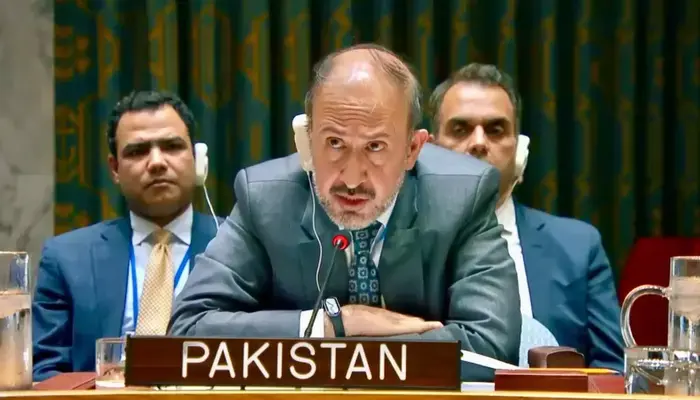
Pakistan has strongly condemned Israel’s continued military attacks and incursions into Syrian territory, demanding an immediate end to the violations and withdrawal from occupied areas.
Speaking at a United Nations Security Council briefing on Syria’s political and humanitarian situation, Pakistan’s Permanent Representative to the UN, Ambassador Syed Haider Shah, called for full compliance with the 1974 Disengagement Agreement and relevant Security Council resolutions.
He stressed that the occupied Golan Heights remained Syrian territory under international law and warned that Israeli actions were undermining Syria’s security and obstructing its recovery.
Ambassador Shah also reaffirmed Pakistan’s support for Syria’s political transition, reconstruction efforts and initiatives to restore stability after years of conflict.
Read more: Iran Calls Pakistan a Trusted Friend as Araghchi Says 10-Nation Bloc Backs Hormuz Plan
Pakistan Calls for Respect for Syria’s Territorial Integrity
Addressing the Security Council, Ambassador Shah said Syria’s political transition was continuing despite significant challenges and a complicated regional environment.
He welcomed the Syrian government’s efforts to rebuild national institutions, advance the political transition and strengthen relations with regional and international partners.

The Pakistani envoy said sustaining progress would require continued political engagement, economic opportunities and a secure environment.
He also appreciated the Syrian leadership’s emphasis on diplomacy and dialogue to navigate regional challenges.
Pakistan reiterated that Israel’s continued presence in occupied Syrian territory violated international principles and threatened efforts to establish lasting stability.
The ambassador called for Israel to end its incursions, withdraw from occupied areas and respect the existing disengagement arrangements.
Pakistan Welcomes Sanctions Relief and Reconstruction Efforts
Pakistan also welcomed measures taken by the United States, European Union and United Kingdom to lift or ease economic sanctions on Syria.
Ambassador Shah said these measures had created opportunities for investment, reconstruction and Syria’s reintegration into the international economy.
He emphasised that sustained international engagement would be necessary to turn sanctions relief into tangible economic improvements for ordinary Syrians.
Pakistan also welcomed reconstruction initiatives involving Syria and its regional and international partners.
The envoy said timely implementation of these projects could help restore essential public services and improve living conditions for people affected by years of conflict.
He further called for predictable humanitarian assistance and effective cooperation with the Syrian government, stressing that the scale of humanitarian needs required sustained international support.
Pakistan Supports Political and Security Agreements in Syria
On the security front, Pakistan supported the implementation of the January 29 agreement aimed at integrating security and administrative structures in northeastern Syria into national institutions.
Ambassador Shah also welcomed the roadmap agreed upon by Syria, Jordan and the United States concerning Suwaidah, describing it as a practical way forward.
He warned that Daesh, other terrorist organisations and foreign terrorist fighters continued to threaten Syria’s security.
The Pakistani representative called for coordinated counterterrorism efforts in accordance with international law and relevant UN Security Council resolutions.
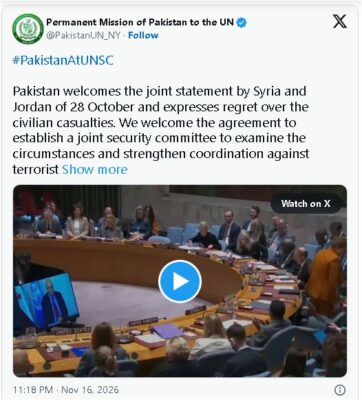
He also welcomed the October 28 joint statement issued by Syria and Jordan, which included an agreement to establish a joint security committee.
The proposed committee aims to examine the circumstances surrounding recent incidents and strengthen cooperation against terrorist threats.
Pakistan expressed regret over civilian casualties and appreciated both countries’ commitment to maintaining close relations.
UN Warns of Rising Dangers From Landmines in Syria
Meanwhile, UN officials highlighted the continuing humanitarian dangers facing Syrians returning to their homes after years of displacement.
UN Assistant Secretary-General for Humanitarian Affairs Mohamed Yahya told the Security Council that landmines and unexploded weapons had killed at least 30 people, including 19 children, over the previous month.
More than 80 others, including 35 children, were injured during the same period.
Yahya warned that returning families faced increasing risks from explosive remnants of war, particularly in areas affected by previous fighting.
Humanitarian organisations had cleared more than 700,000 square metres of contaminated land during the first half of the year. However, the UN official said much more work was needed to protect civilians.
Recent flash floods had also moved explosive materials into areas previously considered safer.
The humanitarian situation remains challenging despite significant population movements. Nearly four million Syrians have voluntarily returned home since December 2024.
Since October, another 60,000 internally displaced people and 18,000 refugees have returned, while more than 730,000 people continue to live in camps.
Millions of Syrians Face Winter Assistance Shortages
The UN also warned that millions of people could struggle to access essential services and shelter during the coming winter.
According to Yahya, around 2.4 million people were expected to require additional winter assistance.
The UN winter response plan, which aims to support more than 970,000 of the most vulnerable people, had received only 40 per cent of its required funding.
Nearly 200,000 displaced people and returnees were also living in damaged shelters.
The humanitarian crisis has been further complicated by the detection of poliovirus in two children in Deir Ez Zor.
With the overall UN humanitarian appeal only one-third funded, the World Food Programme is reducing its food assistance programme by half. The UN Population Fund has also closed 28 health facilities.
Yahya warned that time was running out to address the growing humanitarian needs.
Read more: US Flight Ground Stop Exposes Risks of Aging Air Traffic Control System
UN Calls for Transitional Justice and International Support
Deputy Special Envoy for Syria Claudio Cordone welcomed the formal submission of a draft law on transitional justice, saying accountability must apply equally regardless of the identity of perpetrators or victims.
He stressed that justice should not be selective and that preparations for a permanent constitution and credible, inclusive elections required clear processes and timelines.
Cordone also highlighted the enormous financial requirements for Syria’s reconstruction.
The World Bank estimates that rebuilding damaged physical assets alone would cost approximately $216 billion.
He called for sustained international assistance to help Syria rebuild its infrastructure, restore essential services and establish conditions for long-term stability.
The UN briefing highlighted the scale of challenges facing Syria, ranging from Israeli military incursions and security threats to landmine contamination, displacement and shortages of humanitarian funding.
Pakistan’s position at the Security Council underlined its call for respect for Syria’s territorial integrity, implementation of international agreements and continued international support for the country’s recovery.
-
-

-

-

