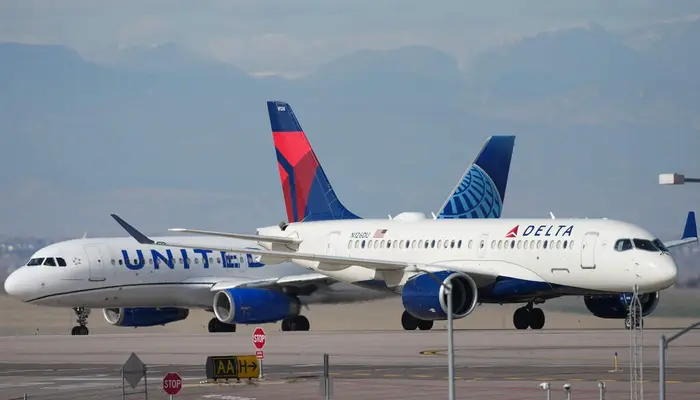
A communications failure across the US Federal Aviation Administration’s (FAA) air traffic control network halted flight departures nationwide for more than four hours on Friday, raising fresh concerns about the reliability of the country’s aging aviation infrastructure.
The FAA ordered a nationwide ground stop after a communications issue affected all Air Route Traffic Control Centers, preventing aircraft from departing airports across the United States.
Transportation Secretary Sean Duffy announced the disruption in a post on X, citing an issue affecting the agency’s communications network.
Duffy later attributed the outage to problems involving the FAA’s legacy infrastructure, saying overloaded switches and routers had stopped functioning after receiving excessive data. Authorities had not immediately established what caused the equipment overload.
The FAA eventually lifted the ground stop after more than four hours. However, Duffy warned that restoring normal air traffic operations would take additional time.
According to aviation analytics firm Cirium, more than 1.5 million passengers were scheduled to depart US airports on approximately 11,000 flights after 4pm Eastern Time, shortly after the ground stop began.
FAA Communications Failure Raises Aviation Safety Concerns
The disruption has renewed questions about the reliability of the technology supporting one of the world’s busiest aviation networks.
The FAA operates hundreds of air traffic facilities responsible for coordinating aircraft movements, communicating with pilots and maintaining safe distances between aircraft.
However, several components of the system rely on outdated computers, telecommunications infrastructure and equipment that cannot communicate seamlessly with one another.
FAA Administrator Bryan Bedford previously told Reuters that more than 300 agency facilities operated as technological silos, with some still depending on systems developed decades ago.
He also highlighted difficulties in maintaining obsolete equipment, with some replacement parts obtained through online auction websites or manufactured using 3D printing.
The latest incident has exposed the consequences of continuing to operate critical aviation infrastructure with technology that struggles to meet modern demands.
Billions of Dollars Sought to Modernise Air Traffic Control
The nationwide disruption occurred on the same day the White House and Transportation Department sought another $30.1 billion from Congress for aviation improvements, including $10.1 billion dedicated to modernising air traffic control infrastructure.
The funding request highlights the scale of investment required to replace outdated equipment, improve telecommunications networks and strengthen the reliability of the country’s aviation system.
Congress had already approved $12.5 billion in July 2025 for modernisation efforts covering telecommunications, radar and other essential air traffic control infrastructure.
The administration said approximately 68 per cent of the FAA’s legacy copper telecommunications network had been replaced with high-speed fibre-optic connections.
However, Bedford previously warned that replacing copper cables with fibre alone would not eliminate the risk of future outages without a broader modernisation of the telecommunications network.
Government Reports Highlight Longstanding System Weaknesses
Concerns about the FAA’s infrastructure have been documented for years.
A 2024 Government Accountability Office (GAO) report found that the FAA had classified 51 of its 138 air traffic control systems as unsustainable and another 54 as potentially unsustainable.
Together, the two categories represented more than three-quarters of the systems reviewed.
The GAO also raised concerns in September 2026 about the planning and management of the modernisation programme.
According to the report, the FAA lacked a reliable overall cost estimate and an integrated master schedule. As of May, the agency had 11,389 separate project schedules that were not coordinated.
The fragmented planning raised concerns about duplicated work, delays and potential cost overruns, potentially extending the period during which the agency would depend on outdated infrastructure.
The FAA aims to complete the first phase of its modernisation programme by December 2028.
Previous FAA Outages Also Disrupted Thousands of Flights
Friday’s nationwide shutdown was the first US-wide flight ground stop since January 2023, when a failure in the system distributing critical safety notices to pilots disrupted aviation operations.
That incident halted departures for less than two hours and affected more than 10,000 flights through delays and cancellations.
Read more: Microsoft Outage Disrupts Outlook, Teams and Copilot, Exposing Risks of Tech Dependence
Another telecommunications disruption occurred in September 2026 after error messages appeared on a circuit serving a Philadelphia air traffic control facility.
The FAA’s contractor switched operations to a backup fibre-optic line, but a construction crew subsequently severed that line in New Jersey, contributing to widespread disruption.
Approximately 9,500 US flights were delayed or cancelled during that incident.
Bedford said the absence of sufficient backup infrastructure remained a major weakness, warning that the system lacked the redundancy expected from a modern architecture.
FAA Faces Pressure to Deliver Modernisation
The latest communications failure has intensified scrutiny of the government’s efforts to modernise the country’s air traffic control network.
Although significant funding has been approved and fibre-optic upgrades are underway, officials face the challenge of replacing interconnected legacy systems without disrupting ongoing aviation operations.
The GAO’s concerns about fragmented planning also raise questions about whether the agency can complete its modernisation targets within the proposed timeframe.
With millions of passengers and thousands of flights depending on reliable air traffic control services, the incident has highlighted the importance of investing in resilient infrastructure, backup communications and modern technology.
The FAA’s December 2028 target remains a key deadline, but Friday’s outage demonstrates why upgrading the country’s aviation network has become an increasingly urgent priority.