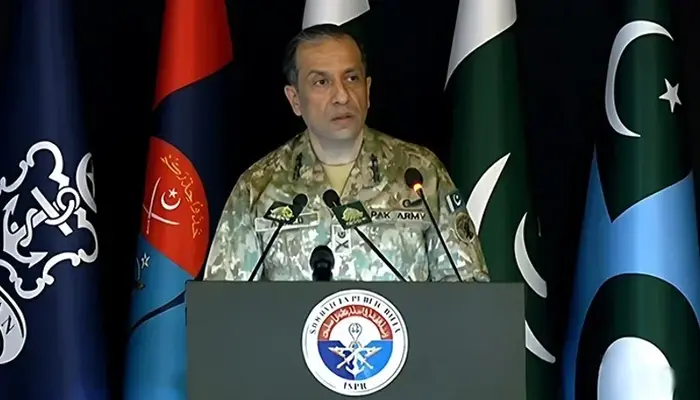
Pakistan has declared that its military is fully prepared to counter potential drone threats from Afghanistan and India, with the armed forces claiming they can intercept any unmanned aircraft entering the country’s airspace. Director General Inter-Services Public Relations (DG ISPR) Lieutenant General Ahmed Sharif Chaudhry said the military was strengthening its technological capabilities, including artificial intelligence, cyber warfare and advanced defence systems, to meet emerging security challenges.
The military spokesperson made the remarks during an interview with an international media outlet on Friday. Pakistani state media shared the interview on Sunday as tensions between Islamabad and Kabul continued over allegations of cross-border terrorism.
Pakistan Says Its Military Can Counter Afghan Drone Threats
Responding to questions about the Afghan Taliban’s potential use of drones against Pakistan, Lt Gen Chaudhry said the nature of modern warfare had changed significantly, requiring professional armed forces to prepare for both conventional and non-contact military operations.
He identified drone operations, cyber warfare and long-range weapons as important components of the evolving security environment.
Addressing concerns about the growing use of unmanned aircraft by non-state actors, he said such capabilities posed challenges for countries across the region and beyond. He referred to the activities of the Houthis, the Afghan Taliban and militant groups operating in the region.
Asked whether Pakistan feared a situation similar to the conflict involving the Houthis and Saudi Arabia, the military spokesperson questioned Afghanistan’s ability to independently develop sophisticated drone technology.
He claimed Afghanistan lacked an established drone industry and the technological infrastructure required to manufacture such systems. He alleged that external sponsors, particularly India, were providing technological assistance to the Afghan Taliban.
These allegations reflect Islamabad’s position on the security situation in Afghanistan and have not been independently established in the interview.
Pakistan Recalls Shooting Down Indian Drones
Referring to the previous military confrontation with India, Lt Gen Chaudhry said Pakistani forces had successfully intercepted dozens of sophisticated Indian drones.
He maintained that the experience had strengthened the military’s confidence in its operational capabilities and preparedness against unmanned aerial threats.
“So we are much ahead where we stand in our own operational readiness,” he said.
He added that Afghanistan could attempt to send drones across the border, but Pakistani forces possessed the capability to detect and intercept them.
The DG ISPR also warned that Pakistan had the capacity to deliver a strong military response if its security was threatened, arguing that Afghanistan would face serious consequences in the event of escalation.
Pakistan Army Incorporates Artificial Intelligence
The interview also addressed the growing importance of artificial intelligence and other emerging technologies in modern military operations.
Asked whether the Pakistan Army used AI to identify potential targets and support military operations, Lt Gen Chaudhry said the armed forces were incorporating technologies necessary to adapt to changing battlefield requirements.
He also referred to developments in quantum technology and cyber capabilities but declined to disclose specific military applications.
“We are using all sorts of technologies. We are a technology-savvy army,” he said.
He stressed that modern militaries could not afford to fall behind as technological advancements continued to transform warfare.
DG ISPR Accuses India of Supporting Militants
Turning to Pakistan’s security concerns, Lt Gen Chaudhry accused India of supporting militant organisations operating against Pakistan.
He described India as the alleged “prime contractor” behind groups including the Tehreek-e-Taliban Pakistan (TTP) and the Balochistan Liberation Army (BLA), claiming they were being used as proxies.
He also rejected allegations by the Afghan Taliban that Pakistan was hosting anti-Taliban groups or coordinating former Afghan government officials and military figures against the current administration in Kabul.
The military spokesperson accused the Afghan Taliban of using non-state actors, militias and mercenaries to advance their objectives.
He further questioned the Afghan administration’s credibility, referring to previous claims involving the alleged capture of a Pakistani pilot and military equipment.
According to Lt Gen Chaudhry, the presence of multiple militant organisations in Afghanistan has been highlighted in international assessments, including United Nations reports.
Pakistan Calls for Action Against Terrorist Groups
Despite the growing tensions, the DG ISPR said Pakistan was not advocating Afghanistan’s international isolation.
Instead, he called on regional countries and the international community to encourage the Afghan Taliban administration to fulfil its responsibilities as a governing authority and prevent militant organisations from operating within its territory.
He also criticised Afghanistan’s alleged involvement in terrorism and drug production, arguing that both activities threatened regional and international security.
Pakistan, he said, remained willing to engage with Kabul but expected the Afghan authorities to stop providing shelter and support to militant leaders.
Read more: Shehbaz Sharif Inaugurates Pakistan-China Friendship Hospital, Orders Free Treatment for All
“We only ask you that don’t support terrorism inside Pakistan. Stop harbouring the terrorist leaders,” he said.
He alleged that militant groups operating inside Pakistan received instructions, weapons and operational assistance from Afghanistan. He also claimed that Afghan nationals, including individuals associated with the Taliban administration, had been found among militant formations targeted by Pakistani forces.
He warned that continued support for militant activities would carry consequences, adding that Pakistan had a strategy to respond to such threats.
Islamabad Says Cross-Border Terrorism Remains Main Obstacle
The remarks came amid deteriorating relations between Pakistan and Afghanistan over repeated militant attacks and security concerns along their shared border.
Pakistan has repeatedly urged the Afghan Taliban administration to prevent the TTP and other militant organisations from using Afghan territory to plan and launch attacks inside Pakistan.
A day before the interview was shared, Pakistan’s Information Ministry maintained that Kabul’s failure to address terrorism remained the biggest obstacle to normal bilateral relations.
Islamabad also alleged that the militant network extended beyond cross-border movement to include training, weapons supplies and operational support.
According to figures cited by Pakistani authorities, terrorism originating from Afghan territory claimed 1,327 Pakistani lives and injured another 2,484 people during 2026.
The security establishment has also alleged that leftover US and NATO military equipment in Afghanistan has reached militant organisations, including groups it identifies as Fitna al-Khawarij and Fitna al-Hindustan.
As diplomatic tensions persist, Islamabad continues to demand concrete action from Kabul against militant networks, while maintaining that engagement between the two countries remains necessary to address their security concerns.
Follow on social media Facebook and Instagram
-

-

-

-