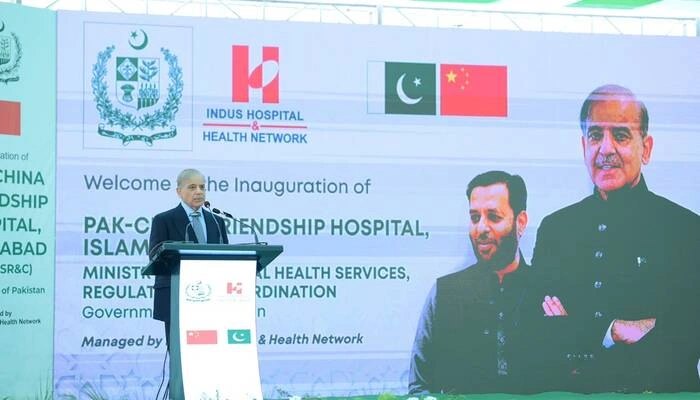
Prime Minister Shehbaz Sharif on Thursday inaugurated the Pakistan-China Friendship Hospital in Islamabad, announcing that the government would cover 100 per cent of treatment costs and ensure free, quality healthcare for patients from across the country.
During his visit to the newly renovated facility, the prime minister directed the health ministry and hospital management to make it a model healthcare institution, stressing that public resources must serve humanity rather than be wasted through administrative neglect.
The 182-bed hospital, including 50 intensive care unit (ICU) beds, will provide medical services to patients from Islamabad, Rawalpindi, Khyber Pakhtunkhwa, Gilgit-Baltistan, Azad Jammu and Kashmir and other parts of Pakistan.
Government to Cover All Treatment Costs
Addressing the inauguration ceremony, Prime Minister Shehbaz Sharif said the government would finance 100 per cent of patient treatment costs, while the Indus Hospital and Health Network (IHHN) would manage the facility under a public-private partnership arrangement.
Read more: Saudi Arabia Intercepts Houthi Missile as Riyadh and Kuwait Reaffirm Defence Ties
He said his experience with hospitals operated by the network had demonstrated the importance of professional management, transparency and accountability in improving public healthcare services.
The prime minister also directed Health Minister Syed Mustafa Kamal and hospital management to ensure that patients received quality treatment without financial barriers.
He ordered a third-party performance audit to monitor healthcare standards and institutional performance, emphasising that the hospital should establish a benchmark for other public-sector medical facilities.
Hospital Revived After Years of Closure
The facility was originally established as the Isolation Hospital and Infectious Treatment Centre (IHITC) and gifted by China to Pakistan during the COVID-19 pandemic.
However, it became non-operational after the pandemic subsided and remained closed for several years.
Expressing regret over the prolonged closure, Shehbaz Sharif described the situation as an example of institutional neglect that deprived vulnerable citizens of an important healthcare resource.
He said he took immediate notice after learning about the hospital’s condition through a newspaper report and instructed the health minister to restore the facility.
The prime minister also apologised to the Chinese ambassador and the people of China for the years during which their country’s gift remained unused.
He praised Chinese President Xi Jinping’s vision of international cooperation and shared responsibility for public welfare, describing the hospital as a symbol of the longstanding friendship between Pakistan and China.
Mustafa Kamal Highlights Growing Healthcare Demand
Federal Health Minister Syed Mustafa Kamal thanked the prime minister for his personal supervision and efforts in completing the hospital’s revival.
He said Islamabad’s population had increased considerably since the capital’s establishment, while patients from neighbouring regions and distant areas also travelled to the city for medical treatment.
According to the minister, the new facility would help address the growing demand for healthcare services and provide relief to patients who require specialised medical attention.
Mustafa Kamal also announced that a 200-bed cancer hospital at the Pakistan Institute of Medical Sciences (PIMS) had been prepared and was expected to become operational next year.
He thanked the Chinese government and people for their contribution, describing the hospital as a valuable gift to Pakistan.
Chinese Ambassador Welcomes Hospital’s Revival
Chinese Ambassador to Pakistan Jiang Zaidong welcomed the inauguration, expressing satisfaction that the former isolation facility had been transformed into a general hospital.
He appreciated the decision to name it the Pakistan-China Friendship Hospital, saying the development reflected the strong relationship between the two countries.
The ambassador also acknowledged Pakistan’s efforts in public welfare, including polio eradication, health card initiatives and youth development.
Referring to Pakistan’s economic indicators, Jiang highlighted improvements in foreign exchange reserves, exports, foreign direct investment and credit ratings.
He expressed China’s willingness to strengthen economic cooperation with Pakistan under the second phase of the China-Pakistan Economic Corridor (CPEC).
The ambassador expressed hope that the hospital would continue serving the public and further strengthen bilateral friendship.
Indus Hospital Network to Manage Healthcare Services
Dr Abdul Bari Khan, Chief Executive Officer of the Indus Hospital and Health Network, thanked the federal government for entrusting the organisation with the hospital’s management.
He said the network currently operated 15 hospitals, 140 primary healthcare clinics, four blood centres and four physical rehabilitation centres across Pakistan, serving approximately 700,000 patients every month.
Dr Bari said the organisation’s annual budget had increased from Rs1 billion during its first year to Rs68 billion in the current year. He added that approximately 70 per cent of its total budget was raised within Pakistan through public support and donations.
He also announced plans to establish a blood centre in Islamabad, expressing confidence that the partnership would expand access to free healthcare services in the federal capital.
The inauguration marks the revival of a previously unused healthcare facility, with the government financing treatment and the Indus Hospital and Health Network responsible for professional management. Its performance will be assessed through third-party audits to ensure accountability and service quality.
Follow on social media Facebook and Instagram
-
-
-

-