
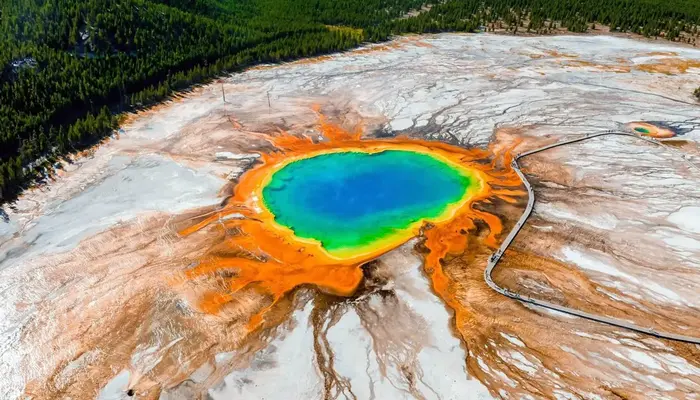
Scientists have uncovered new details about the massive Yellowstone supervolcano, reigniting discussions about where and when it could erupt in the distant future.
New Findings Reveal Hidden Magma Chambers
Yellowstone National Park is famous for its geysers and hot springs, but beneath the surface lies a powerful volcanic system. Recent research has identified four distinct magma bodies underground, with only one in the northeastern region showing signs of long-term activity.
Geologists used advanced instruments to detect electrical signals from molten rock. These tools allowed them to map underground magma chambers without drilling, revealing crucial details about Yellowstone’s volcanic system.
A History of Massive Eruptions
Over the past two million years, Yellowstone has erupted three times, leaving behind giant calderas—huge depressions formed when magma escapes and causes the ground to collapse.
While such eruptions are rare, scientists analyze the region’s heat and rock formations to track potential changes. Each eruption site provides clues about how Yellowstone’s underground system evolves over time.
Tracking Magma with Advanced Technology
To understand Yellowstone’s inner workings, researchers use magnetotelluric instruments that measure the electrical conductivity of underground rock. This method helps identify magma reservoirs, pinpointing where molten rock gathers and how it moves.
Lead researcher Ninfa Bennington of the U.S. Geological Survey (USGS) noted that only the northeastern magma chamber holds enough heat to remain partially molten for the foreseeable future. This finding challenges previous theories that suggested multiple areas could become active.
Will the Northeastern Sector Erupt?
According to the study, the northeastern section of the Yellowstone caldera is the most likely spot for future volcanic activity. However, scientists emphasize that any potential eruption is thousands, if not hundreds of thousands, of years away.
Bennington and her team suggest that the center of volcanic action has shifted to this northeastern zone. This discovery allows researchers to focus their monitoring efforts on a more specific area.
Read: DeepSeek’s AI Breakthrough: A Threat to Nvidia’s Dominance?
How Yellowstone Compares to Other Supervolcanoes
Yellowstone isn’t the only supervolcano on Earth. In Indonesia, Toba erupted 74,000 years ago, causing a massive global cooling event. Scientists compare these volcanic systems to understand how magma behaves over time and what warning signs might appear before an eruption.
Predicting eruptions remains challenging. Researchers monitor seismic activity, ground deformation, and gas emissions for clues. The Yellowstone Volcano Observatory provides real-time updates, ensuring public awareness of any changes.
Separating Facts from Fears
Despite occasional doomsday rumors, geologists stress that supervolcano eruptions are extremely rare. Such events require precise conditions, which Yellowstone does not currently meet.
Small shifts within the system are normal and do not indicate immediate danger. Ongoing research helps reduce uncertainty and provides a clearer picture of how the Yellowstone supervolcano operates.
What Happens If Yellowstone Erupts?
If a supervolcano erupts, it releases massive amounts of ash, gas, and lava into the atmosphere. This debris can impact air quality, water supplies, and transportation across vast regions.
Globally, the thick ash and sulfur dioxide could block sunlight, cooling the planet and disrupting food production. A phenomenon known as a “volcanic winter” could shorten growing seasons, leading to crop failures and economic stress.
A Sleeping Giant Beneath Our Feet
Millions visit Yellowstone National Park every year, unaware they’re walking above a vast, dormant volcanic system. While the northeastern magma body shows some long-term activity, experts agree that an eruption is not imminent.
By studying Yellowstone’s volcanic system, scientists improve their understanding of supervolcanoes worldwide. Ongoing research ensures that, if changes occur, geologists will be ready to respond with the best possible information.
Follow us on Google News, Instagram, YouTube, Facebook,Whats App, and TikTok for latest updates
