
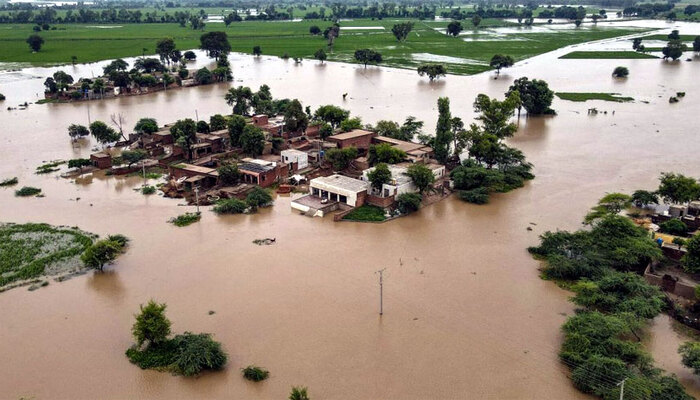
The Jhang flood relief operation has intensified after massive water inflows from the Chenab River submerged more than 130 villages. Authorities are working around the clock to protect embankments, assist stranded families, and ensure food supplies reach those in need. With water levels still rising at key points, the district remains under constant watch.
Villages Submerged by Chenab Waters
Heavy inflows from the Chenab River have inundated large parts of Jhang district. Fields, homes, and livestock have been swept under floodwaters, leaving thousands displaced. Entire stretches of farmland have disappeared, forcing families to seek shelter on higher ground.
The scale of the flooding has created serious challenges for both the local population and the administration. Many villagers have had to abandon their belongings to save their lives. Rescue boats and trucks are being used to evacuate people from low-lying areas, while makeshift camps are being set up for those who lost their homes.
Shrine of Hazrat Sultan Bahoo Impacted
The floodwaters also reached the suburban areas of Jhang. At the shrine of Hazrat Sultan Bahoo (RA), a spiritual landmark visited by thousands annually, authorities closed the main gate due to rising waters. Devotees are still allowed access, but only through alternative gates.
Despite the flooding, religious visitors continue to arrive, underscoring the importance of the site for communities across the region. However, officials are closely monitoring the situation to ensure the safety of pilgrims.
Read: Pakistan Army Rescue Operations Save Lives Across Faisalabad
Rising Water Levels at Key Points
Officials report alarming water flow levels at major points along the Chenab. At Chund Bridge, inflows have surged to 550,000 cusecs, while at Head Trimmu, the level stands at 147,000 cusecs. These figures highlight the intensity of the flood and the potential risks if the flow increases further.
The Irrigation Department remains on high alert. Engineers are patrolling embankments, monitoring pressure points, and coordinating with local authorities to prevent breaches. While all protective dykes are currently safe, constant vigilance is required. Heavy machinery has been stationed at sensitive locations, ready for immediate reinforcement if cracks or leaks appear.
Relief Efforts Underway
Rescue and relief operations are being carried out on a war footing. Teams from local administration, rescue agencies, and volunteers are moving door-to-door in flood-hit areas. Their primary focus is to rescue stranded families, provide drinking water, and distribute essential food items.
Cooked meals and dry rations are being transported to makeshift shelters. Medical teams are also active, offering treatment to those affected by waterborne diseases and other health risks linked to floods. Special attention is being given to children, women, and the elderly, who remain the most vulnerable in such crises.
Government and Agency Coordination
The district administration is working closely with the Irrigation Department, Rescue 1122, and disaster management units. Coordination between civil and military authorities has also been established to ensure quick responses.
Authorities have assured that relief goods will not only reach camps but also directly support those who chose to remain near their submerged villages. Trucks carrying tents, blankets, and medicines are moving into the most affected zones.
Community Response and Volunteerism
Beyond official efforts, local communities have stepped up. Volunteers are helping to guide evacuations, share transport, and arrange food supplies. In many areas, people are opening their homes to host displaced families. Religious institutions and welfare groups have also launched donation drives, collecting food, water, and medicines for distribution.
This community-driven response is proving critical, as the scale of the disaster is far beyond what officials alone can manage. The combined effort is easing the hardships of those who have lost homes, livelihoods, and security.
Challenges of Relief Distribution
Despite the progress, challenges remain significant. Floodwaters have cut off several villages, making it difficult to deliver aid. Rescue boats are operating non-stop, but reaching remote areas still takes time. Road access has been severely restricted in some places due to inundation and damage.
Communication issues are also hampering efforts. With electricity lines disrupted and mobile coverage unstable, coordination between teams sometimes slows. Nevertheless, officials emphasize that relief will continue to reach every corner of the affected areas.
Safeguarding Embankments and Infrastructure
Protecting embankments is at the core of the ongoing response. Engineers are using sandbags, bulldozers, and cranes to strengthen weak points along the river. Surveillance teams remain active day and night to monitor pressure on the dykes.
Bridges, highways, and power stations are also under close watch. Damage to these structures could disrupt not only relief operations but also daily life across the district. Ensuring their safety has therefore become a top priority.
Follow us on Instagram, YouTube, Facebook,, X and TikTok for latest updates
