
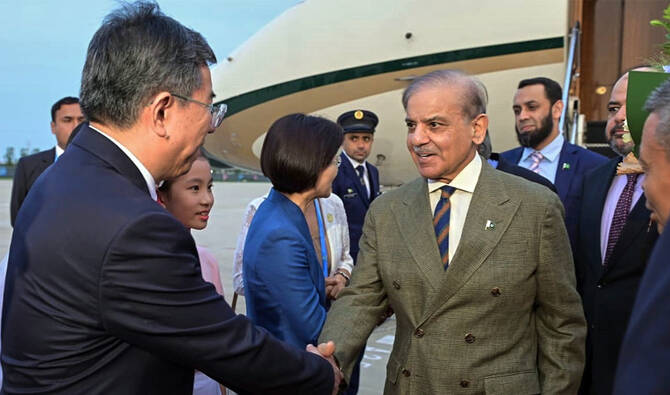
Prime Minister Shehbaz Sharif begins a packed diplomatic schedule as the SCO summit 2025 opens in Tianjin, China. The Pakistani leader is set to meet world leaders, including Türkiye’s President Recep Tayyip Erdoğan, while also addressing students at Tianjin University. His visit underscores Pakistan’s focus on regional cooperation, economic ties, and strategic dialogue.
A Gathering of World Leaders
The Shanghai Cooperation Organization summit has brought together more than 20 world leaders. Indian Prime Minister Narendra Modi, Russian President Vladimir Putin, and Chinese President Xi Jinping are among the key figures in attendance.
China’s Assistant Foreign Minister Liu Bin described the event as the largest SCO gathering since its creation. The forum, which includes China, India, Russia, Pakistan, Iran, Kazakhstan, Kyrgyzstan, Tajikistan, Uzbekistan, and Belarus as members, also engages 16 affiliated states as observers or dialogue partners.
Beijing has long presented the SCO as a counterweight to Western alliances, promoting collaboration in security, economic development, and cultural exchange.
Read: Pakistan Army Rescue Operations Save Lives Across Faisalabad
Pakistan’s Focus at the Summit
According to the Prime Minister’s Office, Shehbaz Sharif’s participation in the summit will include bilateral talks, regional discussions, and public engagements. His meeting with Turkish President Erdoğan is expected to highlight security cooperation and economic partnership.
The prime minister is also scheduled to attend the SCO reception this evening, marking Pakistan’s active role in regional diplomacy. Earlier statements confirmed that Sharif would remain in China until September 4, holding separate meetings with President Xi Jinping and Premier Li Qiang.
Strengthening Pakistan-China Relations
Pakistan’s close partnership with China forms the backbone of this visit. Both countries are working on advancing “CPEC 2.0,” the next phase of the China-Pakistan Economic Corridor. This phase emphasizes industrialization, agricultural modernization, renewable energy, and improved connectivity.
On September 4, Shehbaz Sharif will chair the second Pakistan-China Business-to-Business Investment Conference in Beijing. The event aims to expand investment opportunities and deepen trade links.
Pakistan sees China not only as its largest investor but also as a strategic ally. From infrastructure projects to technology and education exchanges, cooperation continues to shape Pakistan’s long-term development goals.
A Diplomatic Return to China
This is Shehbaz Sharif’s second visit to China since June 2024. During that trip, he met President Xi, visited cultural and educational centers in Xi’an, and announced a program to train 1,000 Pakistani students in agricultural practices.
Last year’s engagements also included talks with Chinese companies in the energy and technology sectors. Pakistan’s government, facing economic challenges, has sought to attract foreign investors, particularly in manufacturing and digital technology.
By returning to China for the SCO summit, the prime minister signals a commitment to strengthening bilateral ties while also engaging in broader regional diplomacy.
First Encounter with Modi Since Military Clashes
One of the most significant elements of this summit is Shehbaz Sharif’s presence alongside Indian Prime Minister Narendra Modi. It marks their first participation together in a multilateral forum since Pakistan and India faced a brief military confrontation earlier this year.
In April, an attack in Indian-administered Kashmir escalated into four days of intense conflict in May. Both sides exchanged missiles, drone strikes, artillery fire, and aerial attacks, leading to over 70 casualties. Washington mediated a ceasefire on May 10, but tensions remain fragile.
The SCO summit offers an opportunity, however limited, for indirect engagement between the two nuclear-armed neighbors.
Deputy PM Ishaq Dar’s Parallel Engagements
While the prime minister engages in high-level diplomacy, Deputy Prime Minister and Foreign Minister Ishaq Dar has been focusing on education and workforce development.
He visited the Luban Technical and Vocational Education and Training (TVET) Exhibition Hall in Tianjin. There, he received a briefing on existing cooperation with Pakistan in technical training. Dar emphasized the importance of expanding collaboration in emerging industries and vocational education.
He stated that strengthening TVET cooperation would not only enhance Pakistan’s human capital but also align with the broader Pakistan-China All-Weather Strategic Cooperative Partnership.
Regional Dynamics and Global Context
The SCO summit comes at a time of shifting global power balances. China’s role in convening leaders from Central Asia, South Asia, and Eurasia signals its ambition to drive multipolar engagement. For Pakistan, the summit is a platform to reinforce its position in regional politics while seeking economic and security cooperation.
With Afghanistan, Iran, and Central Asian states as part of the SCO framework, discussions are expected to cover counterterrorism, connectivity, and trade integration. Pakistan, given its geography, plays a central role in linking these regions.
The Road Ahead
As the SCO summit 2025 unfolds, Pakistan’s leadership aims to balance immediate diplomatic priorities with long-term economic strategy. Engagements with China, Türkiye, Russia, and other partners highlight Pakistan’s efforts to secure investment and strengthen alliances.
The summit also provides an opportunity for Pakistan to project itself as a responsible regional actor, despite recent tensions with India. With global attention on Tianjin, Shehbaz Sharif’s participation reflects Islamabad’s determination to remain an active voice in shaping the region’s future.
Follow us on Instagram, YouTube, Facebook,, X and TikTok for latest updates
