
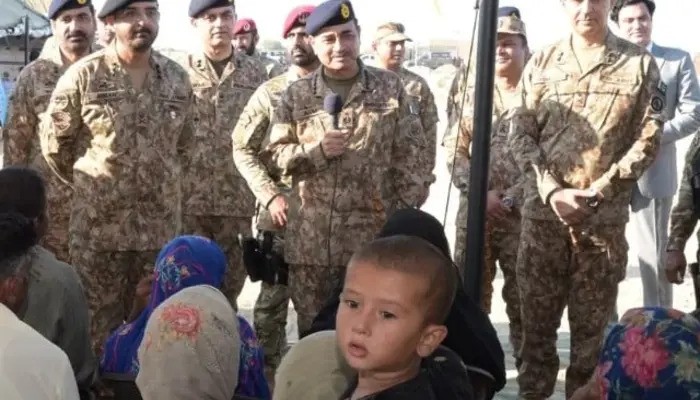
Pakistan’s fight against devastating floods once again highlighted the need for good governance, as Chief of Army Staff (COAS) Field Marshal Asim Munir visited disaster-hit areas on Saturday. He stressed that civil-military coordination must improve to protect communities from recurring destruction, adding that the state cannot afford to lose lives and property every year.
Visit to Flood-Hit Regions
The army chief traveled to Kasur Sector and Jalalpur Pirwala in Multan to review the flood situation. His visit included stops at relief camps, where displaced families are receiving emergency assistance. According to the Inter-Services Public Relations (ISPR), he assessed the scope of damage and observed ongoing rescue and rehabilitation work.
During the trip, Punjab’s chief secretary and senior civil administration officials joined him. Their presence underscored the government’s recognition of the need for unified action.
Emphasis on Civil-Military Synergy
While addressing officials, Munir emphasized the importance of strong cooperation between civil institutions and the military. He explained that only combined efforts can provide lasting protection to vulnerable populations. Rescue operations, he said, must link seamlessly with long-term infrastructure improvements and planning.
“Synergy between the civil administration and military ensures effective relief,” the ISPR quoted him as saying.
Focus on People-Centric Development
Munir urged leaders to prioritize inclusive development. He said governance must be built around people’s needs and highlighted the importance of investing in long-term solutions. Roads, embankments, and drainage systems, he stressed, must be strengthened to prevent yearly disasters.
“The state cannot afford the loss of precious lives and property every year,” he remarked, pointing to the recurring damage caused by floods.
Read: Bears Grip PSX as KSE-100 Index Suffers Sharp Decline
Army’s Role in Relief Efforts
The COAS reaffirmed the Pakistan Army’s commitment to stand with citizens during crises. He said the military would continue to support initiatives that enhance public welfare, particularly in disaster-hit regions.
He acknowledged the tireless work of troops, Rescue 1122 teams, and police officers. Their coordination, he noted, has ensured timely delivery of food, medical aid, and shelter. He praised their morale and dedication, calling their “round-the-clock efforts” an example of service in the nation’s interest.
Direct Interaction with Victims
At the relief camps, Munir met families who had been displaced by the floods. Many expressed gratitude for the military’s quick response, saying timely action saved lives. The COAS assured them that rehabilitation and resettlement would remain a priority.
“Your hardships are our responsibility,” he told evacuees. His words aimed to reassure families facing uncertainty and loss.
Aerial Assessment of Affected Zones
Later, the COAS conducted an aerial reconnaissance over Kasur and Multan to personally inspect the extent of the damage. He observed submerged villages, destroyed farmland, and blocked routes. This overview allowed him to better gauge the impact on both lives and livelihoods.
The aerial inspection also highlighted areas where relief supplies were struggling to reach, reinforcing the need for infrastructure development to make communities more resilient in the future.
Good Governance as a Shield Against Floods
Munir’s repeated call for good governance reflected a broader national concern. Pakistan faces floods almost every year, yet little has been done to break the cycle of loss. Experts agree that disaster response alone is not enough; better planning, strong institutions, and transparent governance are essential to protect vulnerable citizens.
By framing governance as a shield against disaster, the COAS linked immediate relief to the larger project of reform. His words suggest that Pakistan’s military leadership sees governance not just as an administrative issue but as a critical part of national security.
Public Response and Broader Implications
The COAS’s visit has resonated with many across Pakistan. For flood victims, his presence showed that their suffering has not been ignored. For policymakers, his remarks underscored the urgency of aligning governance with disaster preparedness.
Observers note that frequent flooding will continue to strain resources unless systemic reforms are implemented. Munir’s focus on coordination signals a push for accountability and stronger partnerships between civil institutions and the armed forces.
A Call for Action
The recurring devastation from floods has made it clear that Pakistan cannot rely on temporary fixes. Relief camps and food distribution, though essential, cannot replace long-term planning. Munir’s remarks placed responsibility squarely on the state to prioritize the people’s safety and dignity.
By calling for better governance, stronger infrastructure, and united efforts, the COAS highlighted a path forward. His visit served as both a gesture of solidarity with flood victims and a reminder that Pakistan’s resilience depends on more than relief—it depends on reform.
Follow us on Instagram, YouTube, Facebook,, X and TikTok for latest updates
