
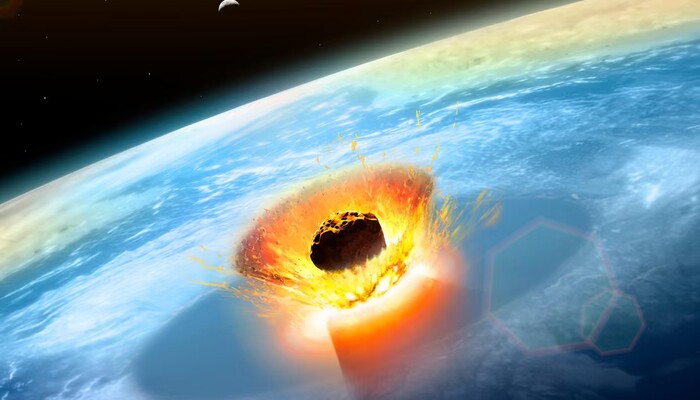
The Silverpit crater buried deep beneath the North Sea has finally revealed its dramatic origin. Scientists now confirm that an asteroid or comet struck the seabed more than 43 million years ago, ending decades of debate. This impact, caused by a space rock roughly the size of York Minster, unleashed a 100-metre-high tsunami and left behind a spectacular scar beneath the ocean floor.
A Mystery Beneath the Seabed
Located about 80 miles off the coast of Yorkshire, the Silverpit crater lies 700 metres below the seabed. Ever since petroleum geoscientists discovered the formation in 2002, experts have argued over its cause. Was it the thrilling result of a high-speed asteroid crash, or the mundane outcome of salt movement deep underground?
For years, many geologists leaned toward the less glamorous explanation. Early estimates dated the crater to more than 60 million years ago, but doubts about an impact remained strong. At a Geological Society debate in 2009, 80 percent of scientists voted against the asteroid theory, favoring a natural salt-related collapse instead.
New Evidence Changes the Story
Fresh research has shifted the consensus. A team led by sedimentologist Uisdean Nicholson of Heriot-Watt University used advanced seismic imaging, microscopic rock analysis, and numerical models to study the crater. Their findings provide the strongest evidence yet that Silverpit is indeed an impact crater.
Nicholson described the discovery process as “a needle in the haystack approach.” When the data confirmed an asteroid strike, he called it “an exciting moment,” especially after years of skepticism.
The Scale of the Impact
The asteroid that formed Silverpit measured about 160 metres across—roughly the size of a cathedral. Traveling at tremendous speed, it slammed into the ancient seabed with enough force to create a crater two miles wide and a surrounding ring of circular faults stretching 12 miles. The collision generated a tsunami estimated to be 100 metres high, devastating the prehistoric environment.
While the Silverpit event was catastrophic for local life, it was not on the scale of the Chicxulub impact in Mexico that wiped out the dinosaurs 66 million years ago. Chicxulub’s asteroid measured up to nine miles wide and triggered mass extinction, whereas Silverpit’s impact was powerful but far less destructive globally.
Read: iPhone 17 Launch Sparks Global Rush for Pro Models
Discovery and Early Doubts
When geoscientists first spotted the crater’s distinctive circular shape and central peak during oil exploration surveys in 2002, excitement ran high. These features are hallmarks of hypervelocity impacts. Early reports even predicted an asteroid origin, capturing headlines with dramatic possibilities.
However, leading geologists such as Professor John Underhill of the University of Edinburgh argued for a more ordinary cause. He suggested the formation could result from salt layers shifting deep underground. Many scientists agreed, rejecting the more spectacular explanation despite compelling indicators.
Breakthrough Research
Nicholson’s team revisited the site with improved technology and funding from the Natural Environment Research Council. High-resolution seismic images allowed them to examine subsurface structures in unprecedented detail. Microscopic study of rock cuttings revealed shock patterns typical of impact events, while computer models reproduced the crater’s formation under asteroid-collision conditions.
The evidence persuaded researchers that Silverpit fits all the criteria for an impact crater. Nicholson’s previous experience identifying another crater in West Africa strengthened his confidence in the results.
A Rare Geological Treasure
Impact craters on Earth are extraordinarily rare. Plate tectonics and erosion erase most traces of ancient collisions, leaving only about 200 confirmed craters on land and just 33 beneath the oceans. Silverpit stands out as the only known impact crater near the UK and one of the best-preserved examples hidden beneath the sea.
Nicholson highlighted its importance for understanding planetary history. “We can use these findings to learn how asteroid impacts shaped our planet and to predict what might happen if another collision occurs in the future,” he explained.
Lessons for the Future
Although asteroid crashes are extremely rare in human history, they remain a real threat. Studying craters like Silverpit helps scientists model potential future impacts and their effects on oceans and coastlines. The new research not only settles a long-standing scientific dispute but also provides valuable insights into Earth’s vulnerability to space hazards.
The Silverpit crater, once dismissed as a geological curiosity, now stands as a dramatic reminder of the forces that have shaped our planet—and the cosmic dangers that still lurk beyond our atmosphere.
Follow us on Instagram, YouTube, Facebook,, X and TikTok for latest updates
