
The West Bank conflict is entering a new and dangerous phase. Israeli settlements continue to expand while several Western nations, including the UK, Canada, and Australia, have recently recognized a Palestinian state. For many Palestinians, this recognition offers symbolic hope even as Israeli forces tighten control over the territory.
A Father’s Loss
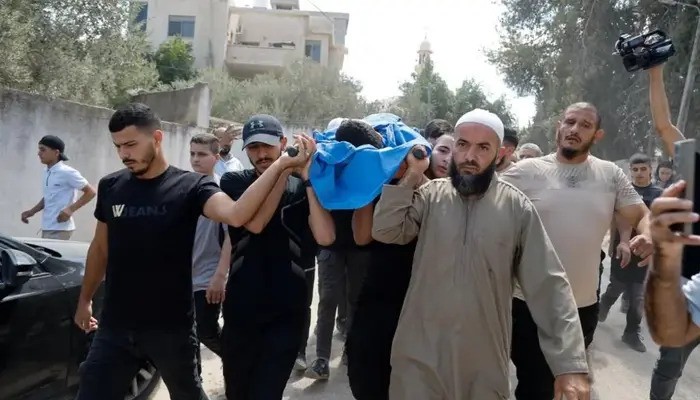
In Jenin, grief and frustration run deep. Abdel Aziz Majarmeh was standing beside his 13-year-old son, Islam, when Israeli forces opened fire earlier this month. The boy was shot dead near the entrance of Jenin refugee camp, which has been under Israeli military occupation since January.
“My son fell to the ground, and then I heard the shot,” Majarmeh recalled. Israeli soldiers ordered him to leave as he tried to drag his son to safety. “Why shoot a child when I was standing right there? Shoot me instead,” he said.
The Israeli army claimed its soldiers fired to neutralize a threat but has not explained what danger the teenager posed. Majarmeh, like many Palestinians, feels powerless. He blames both Israeli forces and the Palestinian Authority (PA), which he says “cannot even protect itself.”
Read: Pro-Palestine Demonstrators Rally in Berlin for Gaza Children
From Peace Accords to Occupation
Three decades ago, Jenin was supposed to be under full Palestinian control under the Oslo Peace Accords. Those agreements were intended to pave the way toward Palestinian statehood. Instead, Israel argues that terrorism took root in these cities, prompting military operations.
In January, Israeli forces entered Jenin and nearby Tulkarem with tanks, claiming they were eliminating armed groups. They have remained ever since, demolishing buildings, razing large areas of the camps, and displacing residents. Jenin’s mayor, Mohammed Jarrar, estimates that 40% of the city is now a military zone and that a quarter of its people have been forced from their homes.
“This is not just a security operation,” Jarrar said. “This is preparation for annexation of the West Bank.”
Recognition Amid Expansion
While Israeli troops tighten their grip, diplomatic moves overseas signal a different reality. The UK, Canada, and Australia recently joined more than 140 nations in recognizing a Palestinian state. For Jarrar, this recognition matters despite the risks.
“It confirms that the Palestinian people possess a state, even under occupation,” he said. “Yes, recognition may bring more Israeli occupation in the short term, but it shapes our future and forces the world to defend our rights.”
Israeli Prime Minister Benjamin Netanyahu rejects this idea outright. “There will be no Palestinian state,” he declared to West Bank settlers last week. His government continues to push settlement growth and resist any negotiations on statehood.
Settlements on the Rise
Israel seized the West Bank from Jordan during the 1967 Arab-Israeli war and has never withdrawn. International law considers settlements illegal, but Israel claims historic rights to the land. Around half a million settlers now live across the West Bank, with more than 100 new outposts established in the past two years, according to the Israeli group Peace Now.
Many of these outposts are illegal even under Israeli law, yet they often receive government support in the form of roads, utilities, and security. Finance Minister Bezalel Smotrich has proposed formally annexing up to 82% of the West Bank, leaving Palestinians isolated in scattered enclaves.
Life Under Pressure
For Palestinians like Ayman Soufan, settlement expansion is a daily threat. From his home near Nablus, Soufan can see a new settler outpost built just months ago. “They bang on the house and shout ‘leave, leave,’” he said. “They throw garbage at our door. I call the authorities, but the army never comes. The settlers are the army.”
Soufan’s family home has been attacked and set on fire several times. His father died of a heart attack during one such attack in 2003. Despite the danger, Soufan refuses to leave. “If I ever leave this house, it will be when I am carried out dead,” he said.
A Political Showdown
The growing recognition of Palestinian statehood by Western nations underscores a widening rift with Israel. The United States has opposed unilateral recognition but has not condemned Israeli settlement expansion. By moving forward, countries like the UK and France signal that Israel cannot indefinitely block Palestinian statehood.
Yet on the ground, facts speak louder than diplomacy. Settlements continue to expand, military operations persist, and Palestinian institutions remain weakened. For families like the Majarmehs and Soufans, the promise of recognition feels distant as daily life becomes more precarious.
As the conflict deepens, Palestinians cling to the hope that international recognition will one day translate into real sovereignty—even as Israeli control grows stronger with each new outpost and checkpoint.
Follow us on Instagram, YouTube, Facebook,, X and TikTok for latest updates
