
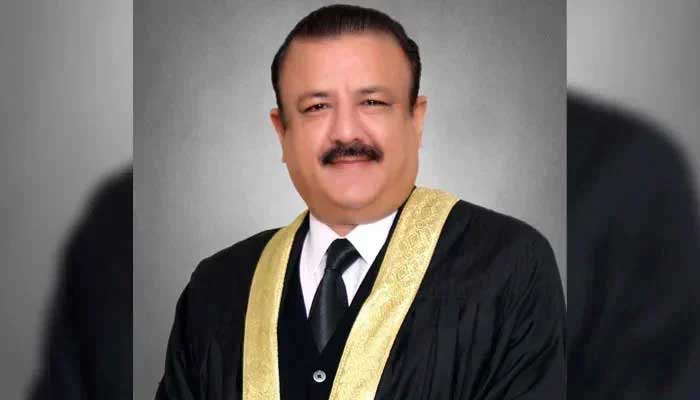
The Supreme Court of Pakistan has suspended an Islamabad High Court (IHC) order that barred Justice Tariq Mehmood Jahangiri from performing judicial duties, bringing fresh attention to the ongoing degree controversy surrounding the senior judge. The high-stakes case, tied to the cancellation of Justice Jahangiri’s LLB degree, has now moved to the country’s top court as questions of authority, legality, and judicial independence take center stage.
Apex Court Steps In
On Monday, a five-member constitutional bench of the Supreme Court took up Justice Jahangiri’s appeal and issued notices to all relevant parties, including the Attorney General’s office. The bench, headed by Justice Amin-ud-Din Khan and comprising Justices Jamal Khan Mandokhail, Muhammad Ali Mazhar, Syed Hasan Azhar Rizvi, and Shahid Bilal Hassan, announced that the hearing would continue on Tuesday.
The bench acted on a petition challenging the IHC’s September 16 order, which had directed Justice Jahangiri to stop judicial work until the Supreme Judicial Council (SJC) ruled on a complaint filed against him.
Read: President’s Power to Transfer High Court Judges Explained
Background of the IHC Decision
Earlier, a two-member IHC bench led by Chief Justice Sardar Muhammad Sarfraz Dogar and Justice Mohammad Azam Khan restrained Justice Jahangiri from court duties. The order came in response to a petition filed by lawyer Mian Dawood, who questioned the legitimacy of the judge’s law degree.
The IHC ruling triggered swift reactions from within the court itself. Five IHC judges, including Justice Jahangiri, Justice Mohsin Akhtar Kiyani, Justice Babar Sattar, Justice Saman Rifat, and Justice Ejaz Ishaq Khan, separately approached the Supreme Court to challenge the divisional bench’s directive.
University of Karachi Cancels Degree
The dispute intensified when the University of Karachi (UoK) cancelled Justice Jahangiri’s LLB degree last week. A university notification dated September 25 revealed that the UoK syndicate, during a meeting on August 31, 2024, approved “Resolution No. 06” on the recommendation of its Unfair Means Committee (UFM).
The committee accused Justice Jahangiri of using unfair means to obtain his degree and imposed a three-year ban on his admission to any educational institution or appearance in any university examination. The notification further stated that records showed Justice Jahangiri was never enrolled as a student at Islamia Law College, Karachi, in 1989, contradicting his academic claim.
Legal Challenge in Sindh High Court
Parallel to the Supreme Court proceedings, Justice Jahangiri has also challenged the University of Karachi’s decision in the Sindh High Court (SHC). In his petition filed under Article 199(1)(a)(ii), he requested the court to declare the actions of the UoK Syndicate and UFM Committee illegal and beyond their jurisdiction.
The plea argued that the UoK Act does not empower the syndicate to cancel a degree once issued, stating that only a civil court holds such authority. Justice Jahangiri’s counsel insisted that the university exceeded its mandate and that the decision should be declared null and void.
Objections and Bench Dispute in SHC
The legal battle in the SHC has faced its own procedural disputes. Justice Jahangiri’s counsel objected to the constitutional bench’s decision to take up the petitions after they were initially scheduled before another bench for September 30. The lawyers protested when the bench declined to recuse itself, arguing that the matter should be heard by a regular bench.
Despite the protest, the SHC bench maintained that a constitutional bench was the proper forum because the relief sought involved constitutional interpretation. The judges emphasized that all objections regarding maintainability would be addressed during the hearing.
Supreme Court’s Immediate Relief
The Supreme Court’s suspension of the IHC order provides immediate relief to Justice Jahangiri, allowing him to resume judicial work while the case proceeds. By issuing notices to all concerned parties, the apex court signaled its intent to thoroughly examine the authority of both the IHC and the University of Karachi in taking actions that directly impact a sitting high court judge.
Broader Implications
This case carries significant implications for the judiciary and academic institutions in Pakistan. It raises critical questions about the limits of university powers, the role of oversight bodies like the Supreme Judicial Council, and the protection of judicial independence.
While the Supreme Court’s decision is temporary, it underscores the importance of due process and the need for clear legal boundaries. The coming hearings will determine whether the University of Karachi acted within its authority and whether the IHC’s order violated constitutional safeguards for judges.
Next Phase in a High-Stakes Battle
As the Supreme Court resumes its hearing, all eyes remain on the interplay between judicial accountability and institutional autonomy. The outcome will not only shape Justice Jahangiri’s career but may also set a precedent for how academic disputes involving members of the judiciary are handled in the future.
The degree controversy has now grown beyond a personal challenge for Justice Jahangiri, evolving into a test case for Pakistan’s legal system and its ability to balance institutional authority with constitutional protections.
Follow us on Instagram, YouTube, Facebook,, X and TikTok for latest updates
