Asteroid 2025 QD8, a newly discovered near-Earth asteroid, will make a dramatic pass by our planet this week. The asteroid, about the size of a commercial airliner, will zoom past Earth at a blistering speed while posing no danger. Its flyby offers a rare chance to witness space in action, and astronomy enthusiasts can watch the event unfold live online.
A Close Encounter in Space
The asteroid will make its closest approach on September 3 at 10:57 a.m. ET (1456 GMT). At that moment, it will be only 135,465 miles (218,009 kilometers) away. This distance equals roughly 57% of the space between Earth and the moon. Although this sounds close in cosmic terms, the asteroid poses no threat to Earth or the moon.
Its estimated size ranges from 55 to 124 feet (17 to 38 meters). While impressive, this makes it much smaller than the asteroids considered potentially catastrophic. Still, the encounter highlights the importance of tracking near-Earth objects and understanding their movement.
Live Stream of the Flyby
The Virtual Telescope Project will broadcast the approach live on YouTube. The coverage begins at 7 p.m. ET (23:00 GMT) on September 2, hours before the asteroid makes its closest pass. Using a network of robotic telescopes based in Manciano, Italy, the project will capture real-time views of the asteroid against the starry backdrop.
This live stream allows people worldwide to experience the encounter without specialized equipment. The broadcast also gives scientists and educators a valuable tool to explain the dynamics of asteroids and their orbits.
Speeding Through Space
Asteroid 2025 QD8 is racing through space at an extraordinary pace. It will travel at more than 28,000 miles per hour (45,000 kilometers per hour) relative to Earth. This velocity underlines how quickly space rocks move through our solar system, often unnoticed until discovered by observatories.
Despite its speed, the asteroid’s trajectory is well known, and experts confirm it will safely miss Earth. Such events offer reassurance that observation programs are effectively monitoring the skies.
Read: Canada’s Lunar Rover Sparks New Era of Space Exploration
First Images Captured
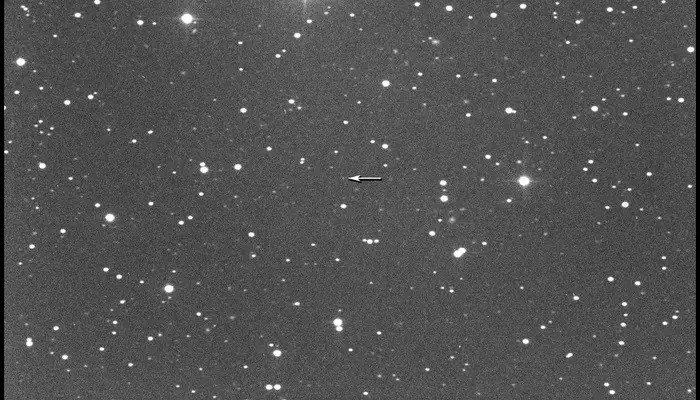
The Virtual Telescope Project managed to capture the first image of the asteroid on August 30. At that time, the object was still 2.4 million miles (3.9 million kilometers) away. Using its 17-inch telescope, affectionately nicknamed “Elena,” the team recorded a 300-second exposure.
In the image, the asteroid appears as a tiny dot among a crowded starfield. Though faint and distant, the photograph confirms its path toward Earth and demonstrates the skill of astronomers in identifying small, fast-moving bodies.
Why Tracking Asteroids Matters
NASA and international partners have cataloged tens of thousands of near-Earth asteroids. A subset of these are classified as potentially hazardous objects. They earn this designation not because they are on a collision course today, but because their orbits cross close enough to Earth’s path to pose a risk in the future.
According to the Center for Near Earth Object Studies at NASA’s Jet Propulsion Laboratory, the likelihood of a destructive asteroid impact within the next century remains extremely low. Still, monitoring efforts continue because even smaller asteroids can cause significant local damage if they strike.
Lessons From the Past
History provides reminders of why asteroid monitoring is essential. In 2013, a 66-foot (20-meter) wide asteroid exploded over Chelyabinsk, Russia. The shockwave shattered windows across the city and injured more than 1,000 people. While Asteroid 2025 QD8 is not on a collision course, its size is comparable to that object.
Events like Chelyabinsk demonstrate why scientists emphasize preparedness and tracking. Understanding the orbits of space rocks gives humanity time to respond if one is ever predicted to collide with Earth.
Asteroids and Public Interest
Asteroid flybys often capture the public’s imagination. Watching an object from deep space skim past our planet highlights the dynamic and sometimes unpredictable nature of the solar system. It also bridges the gap between professional astronomy and public curiosity.
Projects such as the Virtual Telescope Project provide an accessible way for anyone to observe these encounters. By sharing live streams and images, they bring space science to classrooms, homes, and community groups around the world.
Looking Beyond This Flyby
While 2025 QD8 is the asteroid in the spotlight this week, many others pass close to Earth every year. Most remain unnoticed by the public unless they are especially large or come within the Earth-moon distance. For scientists, however, each asteroid presents an opportunity to refine tracking methods, study composition, and test planetary defense strategies.
Future space missions, including NASA’s planetary defense projects, aim to develop ways to deflect or disrupt asteroids should one ever threaten Earth. Observations of near-miss objects like 2025 QD8 feed valuable data into these efforts.
A Window Into the Solar System
The flyby of Asteroid 2025 QD8 is more than a passing spectacle. It serves as a reminder of our planet’s place in a busy solar system. Every close approach brings insights about asteroid movement, planetary defense, and the need for constant vigilance.
Thanks to technology and global cooperation, humanity can now watch these encounters in real time. For those tuning in on September 2, the experience will be both thrilling and educational — a front-row seat to one of nature’s fastest travelers.
Follow us on Instagram, YouTube, Facebook,, X and TikTok for latest updates
-

-

-

-