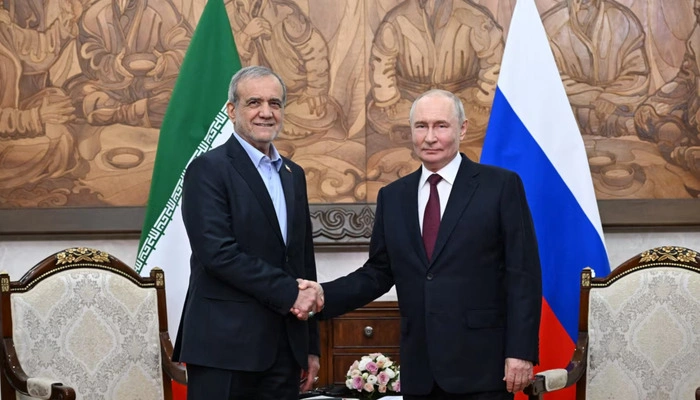
Iran has delivered a pointed message about US influence in the Middle East as President Masoud Pezeshkian met Russian President Vladimir Putin in Moscow, declaring that countries in the region could resolve their problems without relying on Washington. The meeting comes as Tehran strengthens ties with Moscow and holds separate diplomatic discussions with Pakistan, Saudi Arabia and Turkey amid the ongoing war.
Pezeshkian made the remarks during talks with Putin on Tuesday on the sidelines of a summit of the Gas Exporting Countries Forum. He highlighted expanding trade between Iran and Russia and said US actions were encouraging countries facing unilateral American sanctions to deepen cooperation with one another.
The discussions placed Iran’s relationship with Russia and its efforts to engage regional powers in focus as the conflict continues to raise concerns over security, energy supplies and the future of the Middle East.
Pezeshkian Tells Putin the Region Does Not Need US Involvement
Pezeshkian told Putin that countries in the Middle East had the capacity to resolve regional disputes without depending on the United States.
The Iranian president also stressed the importance of expanding cooperation with Russia and other countries affected by US sanctions. He said Tehran and Moscow were making progress in trade and could strengthen ties across science, industry, culture, security and military affairs.
Putin acknowledged the seriousness of the regional situation, saying he had discussed the war with Pezeshkian and hoped developments would move in a positive direction.
The meeting reinforced the importance both governments place on their relationship as tensions with Washington continue. Russia has maintained close ties with Iran and has sought to play a diplomatic role in efforts to end the conflict.
However, neither leader announced a breakthrough towards ending the war during the meeting.
Iran Holds Separate Talks With Pakistan, Saudi Arabia and Turkey
While Pezeshkian met Putin in Moscow, Iran also pursued discussions with regional powers over security and the conditions for ending the conflict.
Iranian security chief Mohsen Rezaei met Supreme Leader Ayatollah Mojtaba Khamenei on Tuesday, following talks with representatives from Pakistan, Saudi Arabia and Turkey.
Iranian state media reported that Khamenei stressed the importance of protecting Iran’s national interests and maintaining Tehran’s conditions for ending the war.
The discussions also covered regional security and the Strait of Hormuz, a vital passage for international oil and gas shipments.
Pakistan, Saudi Arabia and Turkey have their own security and economic interests in the region. Their engagement with Tehran provides a diplomatic channel for discussing the conflict, although it does not mean the countries have agreed on all the issues involved.
Strait of Hormuz Adds to Regional Concerns
The Strait of Hormuz remains one of the most sensitive issues in the crisis because of its importance to global energy markets.
Any disruption to shipping through the waterway can affect oil and gas supplies, increase transportation costs and create uncertainty for energy-importing countries.
Iranian officials have linked regional security and control of the strait to their broader position on ending the war. The issue adds another layer of complexity to diplomatic efforts involving Tehran and other regional governments.
The nuclear dispute also remains unresolved. An Iranian official said Tehran would not discuss its nuclear programme at the meeting with representatives of Pakistan, Saudi Arabia and Turkey until its demands for ending the war were addressed.
Iran maintains that its nuclear programme is peaceful, while Western governments have raised concerns about its potential military implications.
Read more: Israel Election Deadlock Leaves Netanyahu and Rival Without Clear Majority
Will Russia and Regional Powers Help End the War?
Iran’s simultaneous engagement with Russia and regional governments highlights Tehran’s efforts to broaden its diplomatic options as the conflict continues.
Moscow remains an important political and economic partner for Tehran, while contacts with Pakistan, Saudi Arabia and Turkey offer additional opportunities to discuss regional security and possible steps towards de-escalation.
But diplomatic engagement does not guarantee a ceasefire. Any settlement will depend on whether the parties can address their differences over security, sanctions, maritime access and Iran’s nuclear programme.