Brazilian President Luiz Inácio Lula da Silva has secured a historic fourth presidential term after defeating conservative challenger Flávio Bolsonaro in Sunday’s runoff, according to the country’s electoral authority. The result gives Lula another mandate to lead Latin America’s largest economy and maintain his independent foreign policy amid tensions with US President Donald Trump.
With all votes counted, Lula received 51.79% of valid votes, securing 64.26 million ballots. Bolsonaro won 48.21%, or 59.83 million votes, leaving a margin of approximately 4.43 million votes between the candidates.
Bolsonaro refused to concede defeat and said he would seek to annul the result, citing a last-minute decision to extend voting hours at some polling stations. However, electoral authorities said the extension did not change the final outcome.
Lula Celebrates Historic Election Victory
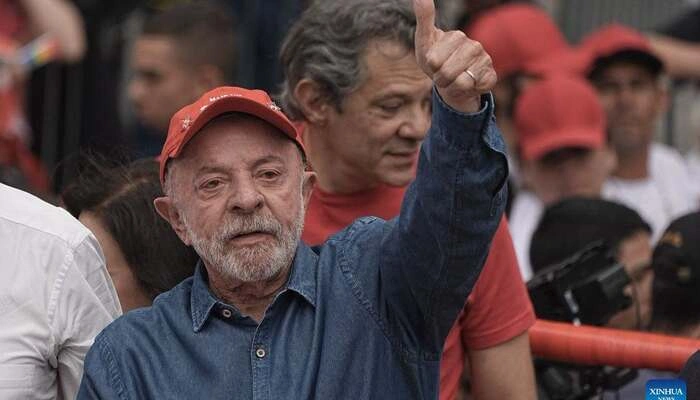
Lula celebrated the result alongside First Lady Rosângela da Silva and political allies after the electoral court confirmed his victory. Thousands of supporters gathered in São Paulo and Rio de Janeiro, waving flags and celebrating the outcome.
Addressing his supporters, Lula thanked Brazilian voters and pledged to respect citizens regardless of their political views, gender or religion. He also criticised what he described as denialism and lies during the campaign.
The president reiterated his commitment to Brazil’s national sovereignty, declaring that the country would not accept being treated as another nation’s backyard.
His remarks reflected a central theme of his campaign: defending Brazil’s independence in foreign policy while resisting pressure from Washington over trade and other issues.
The outcome also challenges a broader regional trend in which several right-leaning candidates aligned with Trump have gained political ground. Brazil’s economic size and international influence make its relationship with the United States particularly significant for regional politics and global trade.
Flávio Bolsonaro Rejects Result and Seeks Annulment
Bolsonaro questioned the legitimacy of the election after the Supreme Court authorised an extension of voting hours shortly before the scheduled closing time.
Justice Cristiano Zanin issued the decision following requests from both campaigns. Lula’s campaign cited transport problems affecting voters in São Paulo and Salvador, while Bolsonaro’s side pointed to heavy rain in southern Brazil, where he had stronger support.
The decision created confusion because some polling stations had already closed before the extension was announced. It also delayed the counting process.
Bolsonaro criticised Zanin, who previously served as Lula’s lawyer, arguing that the rules had changed during the election. He said he could not recognise the result under those circumstances.
However, overturning the outcome would require a legal basis. Electoral authorities maintained that the extension did not affect the final result, while legal experts said Bolsonaro would need to demonstrate that the decision compromised voters’ ability to express their choices freely.
A request for annulment would not automatically invalidate the election. Any legal challenge would have to proceed through Brazil’s electoral justice system and satisfy the relevant requirements.
A Remarkable Turnaround in Brazil’s Presidential Race
The result marked an unusual reversal in Brazil’s presidential election. Bolsonaro led Lula in the first round earlier in October, receiving approximately 47% of the vote compared with Lula’s 45%.
Lula subsequently reorganised his campaign, appealed to younger voters and mobilised supporters around democratic values and his record in office.
Read more: Trump Compares Abdul El-Sayed to 9/11 Attackers Ahead of Michigan Senate Election
His runoff victory made him the first candidate in Brazil’s presidential elections since the end of military rule in 1985 to finish second in the first round and then win the presidency in the second.
Lula’s political career spans severa . He began as a union leader in the 1970s and helped establish the Workers’ Party before winning the presidency in 2002. He secured another term in 2006 and later supported Dilma Rousseff, who became president in 2011.
His political fortunes changed after corruption convictions led to imprisonment in 2018. He was released after 580 days, and Brazil’s Supreme Court later annulled his convictions. He returned to the presidency after defeating Jair Bolsonaro in the 2022 election.
Economy and Security Remain Major Challenges
The campaign highlighted concerns about the cost of living, public security and corruption. Bolsonaro focused on tackling crime and reducing food prices, while Lula promoted government assistance programmes and measures intended to support households.
Both political camps faced scrutiny over corruption allegations involving associates and family members. These controversies remained a source of debate throughout the campaign.
Lula’s next administration will face pressure to address economic concerns and public safety while governing a politically divided country. Relations with Washington will also remain important amid disagreements over tariffs, trade and US influence in Latin America.