The Iran war has emerged as a major political liability for US President Donald Trump after Vice President JD Vance openly blamed the conflict for the Republicans’ crushing defeat in the midterm elections, exposing growing divisions within the administration over America’s military involvement.
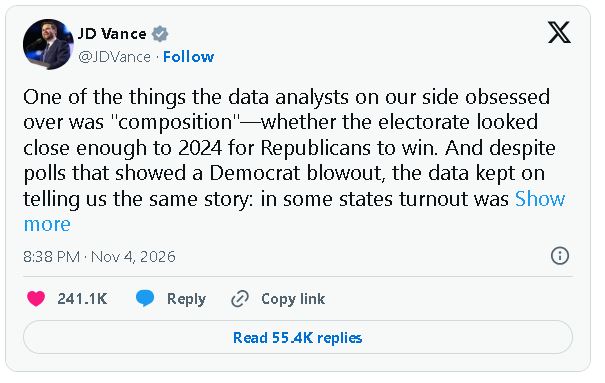
In a lengthy statement posted on X on Wednesday, Vance argued that the war had cost Republicans crucial electoral support, with voters who backed Trump and Vance in the 2024 presidential election switching sides and supporting Democrats in the 2026 midterms.
“The reason we lost is the war. The president himself said so last night,” Vance wrote, referring to Trump’s acknowledgment that the conflict had contributed to the Republican setback.
The vice president’s remarks mark a significant moment for an administration that has defended its military campaign against Iran, even as the conflict continues to generate political and economic pressure at home.
Vance Says Iran War Cost Republicans Voter Support
Vance argued that Republicans needed to confront the consequences of the war rather than dismiss the election results or avoid an honest assessment of why voters abandoned the party.
He challenged supporters of the military campaign to explain whether its objectives justified the political consequences, including the loss of Senate control for the next six years.
“If you’d like to argue it was worth it, that losing the Senate for the next 6 years was worth it, then do so,” Vance wrote, adding that any serious discussion about the party’s future must begin with an acknowledgment of the war’s political impact.
Read more: Abdul El-Sayed Makes History With Projected Michigan Senate Victory
The vice president also highlighted the growing frustration among voters who supported the Republican ticket in 2024 but backed Democratic candidates two years later.
According to Vance, polling conducted by a surveyor he respected identified the war and economic pressures as major reasons behind the shift in voter preferences.
He listed four leading demands from former Republican supporters who wanted to reconsider their political allegiance: ending the war, addressing the cost of living and inflation, prioritising America’s interests and changing the country’s relationship with Israel.
The findings suggest that foreign policy and domestic economic concerns have become closely connected in the minds of voters, creating a difficult challenge for Republican leadership.
Trump Defends Iran Campaign Despite Election Defeat
Despite acknowledging the political damage, Trump refused to suggest that the military campaign had been a mistake.
Speaking to reporters at the construction site of his White House ballroom shortly after Vance’s statement, the president said the vice president’s assessment was “largely true”.
Trump acknowledged that the conflict had pushed gasoline prices higher in the short term, potentially contributing to voter dissatisfaction.
However, he maintained that the military campaign remained necessary to prevent Iran from developing nuclear weapons.
“But at the same time, if I had it to do again, I’d have to do it again. Because long term, it’s the only answer. You can’t let Iran have a nuclear weapon,” Trump said.
His comments highlighted the contrasting positions emerging within the administration, with Vance emphasising the political consequences while Trump continued to defend the strategic justification for the war.
Read more: Jesús de Miguel Dies at 30 After Suffering Cardiac Arrest During Live Football Match
Trump also dismissed speculation about removing Defence Secretary Pete Hegseth, a strong supporter of the military campaign, saying he believed the defence chief was doing a very good job.
Democrats Prepare to Challenge Trump’s Iran Policy
The Republican defeat has also strengthened Democrats’ position as they prepare to take greater control of Congress.
Senate Democratic Leader Chuck Schumer called for an end to the Iran war, arguing that the American public had not received a clear explanation of the objectives behind the military campaign.
“The American people don’t know what the heck we’re fighting for in Iran,” Schumer told reporters.
He accused Trump of repeatedly changing his position on the conflict and failing to provide a consistent explanation of its purpose.
Schumer also suggested that Democrats could use their control over government funding to pressure the administration into changing its approach.
He described Congress’s financial authority as an important mechanism for restraining a president who pursues military action without sufficient public support.
The Democratic leader further warned that his party would intensify investigations, pursue legal challenges and use legislative powers to scrutinise Trump’s administration.
Vance’s 2028 Presidential Ambitions Face New Questions
The election outcome and Vance’s public criticism have raised questions about his political future, particularly as he has been viewed as a leading potential Republican presidential candidate for the 2028 election.
Although Vance has not formally announced a presidential campaign, his comments could signal an effort to distinguish his political position from Trump’s foreign policy decisions.
The vice president has previously expressed reservations about overseas military interventions and has built much of his political identity around prioritising American interests.
His latest remarks could appeal to Republican voters frustrated by the economic and political consequences of the Iran conflict. However, openly challenging the administration’s position also carries political risks as he considers his future within the party.
With Democrats preparing to use their strengthened congressional position and Republicans facing questions about their electoral strategy, the Iran war is likely to remain a defining issue in the debate over America’s political direction.