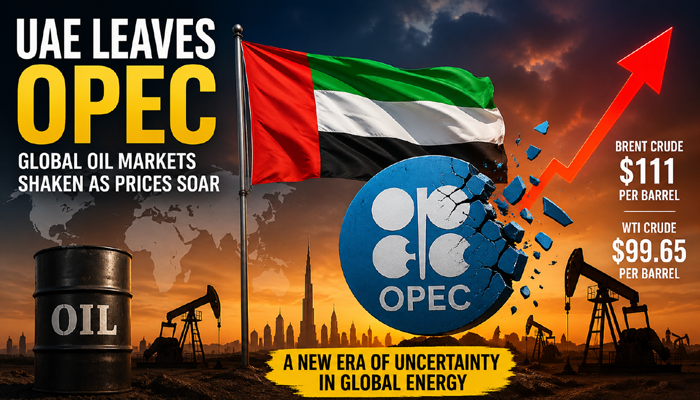
The UAE leaves OPEC in a move that has stunned global markets and raised serious questions about the future of oil alliances. The unexpected decision by the United Arab Emirates to exit the powerful OPEC and its extended alliance OPEC+ signals a dramatic shift in energy geopolitics at a time when the world can least afford instability.
Oil prices reacted instantly. Brent crude surged above $111 per barrel, while West Texas Intermediate climbed close to $100, reflecting market anxiety over supply disruptions and weakening producer coordination.
Read More: Trump Iran Ceasefire Extension: Pakistan in Spotlight
UAE Leaves OPEC and Challenges Saudi Leadership
The UAE’s departure strikes at the heart of OPEC’s unity, long anchored by Saudi Arabia. For decades, the group has maintained influence by coordinating output levels, balancing supply, and stabilizing prices.
However, cracks have been forming beneath the surface. The UAE, traditionally viewed as a disciplined and reliable member, has reportedly grown frustrated with production quotas and internal politics. By stepping away, Abu Dhabi is signaling it wants greater control over its oil strategy and long-term economic ambitions.
This is not just a policy shift; it is a strategic recalibration that could embolden other members to reconsider their positions.
Oil Prices Surge as Markets React to UAE Exit
The immediate market response underscores how critical the UAE’s role has been. Traders fear that without unified coordination, oil-producing nations may begin acting independently, leading to unpredictable supply patterns.
At the same time, geopolitical tensions are intensifying the situation. The ongoing conflict involving Iran has already disrupted regional stability, pushing energy markets into a fragile state.
A key concern is the security of the Strait of Hormuz, a narrow waterway responsible for transporting nearly one-fifth of the world’s oil and liquefied natural gas. Any threat to this corridor has immediate global consequences, and recent warnings and attacks have heightened fears of supply bottlenecks.
UAE Leaves OPEC Amid Rising Regional Friction
The timing of the UAE’s exit is not coincidental. Reports suggest growing dissatisfaction in Abu Dhabi over what it perceives as inadequate regional support during escalating tensions with Iran.
Repeated security threats and attacks have strained alliances within the Gulf, exposing divisions that were previously managed behind closed doors. By leaving OPEC, the UAE may be signaling that economic independence now outweighs collective strategy.
This development also complicates the broader geopolitical landscape, where energy policy and security concerns are increasingly intertwined.
A Strategic Win for Donald Trump
Interestingly, the move aligns with long-standing criticism from Donald Trump, who has frequently accused OPEC of manipulating oil prices. Trump has argued that the United States provides security to Gulf nations while facing higher energy costs as a result of OPEC policies.
The UAE’s exit could be interpreted as validation of those concerns, potentially reshaping how Washington approaches its relationships in the region. It may also influence future U.S. energy diplomacy and military engagement strategies.
What UAE Leaves OPEC Means for the Future
The long-term implications of the UAE’s departure are profound. Without one of its key members, OPEC’s ability to maintain cohesion and influence global oil markets could weaken significantly.
At the same time, the move introduces a new era of competition among oil producers. Countries may prioritize national interests over collective agreements, leading to greater volatility in pricing and supply.
For businesses, investors, and policymakers, this marks the beginning of a more uncertain energy landscape. Strategic planning will need to account for rapid shifts in alliances, production levels, and geopolitical risks.
A Turning Point in Global Energy Politics
The decision as the UAE leaves OPEC is more than a headline; it is a turning point that could redefine how global energy markets operate. With rising tensions, fragile supply routes, and shifting alliances, the world is entering a period of heightened uncertainty.
Whether this leads to innovation and diversification or prolonged instability will depend on how major players respond in the coming months. One thing is clear: the balance of power in global oil is no longer guaranteed.
Read Full Story: UAE leaves OPEC in blow to oil cartel during war on Iran