
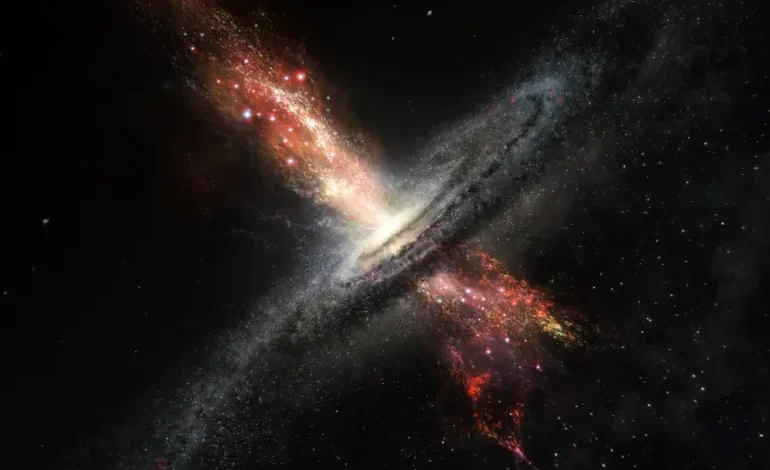
Supermassive black holes, once believed to be unimaginably huge, may not be as massive as earlier theories suggested. Scientists studying a distant quasar more than 12 billion light years away have found evidence that reshapes our understanding of black hole formation. This groundbreaking research, focused on the keyword black hole growth, challenges long-held assumptions about how these cosmic giants evolve in the early universe.
A Surprising Discovery in Deep Space
Astronomers from the University of Southampton, working with European collaborators, observed a young galaxy powered by an intensely bright quasar. Despite its dazzling luminosity, the black hole at the galaxy’s center measured only about one billion times the mass of our sun. That is roughly one-tenth of what scientists had predicted based on current models of black hole growth.
Associate Professor Christian Wolf of the Australian National University (ANU), who co-led the study, explained that the black hole’s modest size defies expectations. “Despite the quasar’s extreme brightness, the black hole’s mass is far smaller than we believed possible,” he said.
Challenging Established Models
For years, astronomers have puzzled over how supermassive black holes could reach billions of solar masses in the universe’s first billion years. Conventional theories proposed that black holes in young galaxies grew rapidly by pulling in surrounding gas and dust at extraordinary rates.
However, this new finding suggests a different story. Instead of feeding voraciously, the black hole is shedding material. Wolf described it as “belching up” gas that is being driven outward by the intense radiation pouring from the quasar. This violent outflow slows the black hole’s growth, preventing it from becoming as massive as scientists once thought.
Advanced Technology Unlocks the Mystery
The breakthrough came thanks to Gravity+, a cutting-edge instrument that combines light from four of the world’s largest telescopes at the European Southern Observatory’s (ESO) Very Large Telescope in Chile. Using this technology, the team analyzed the hot gas spiraling around the black hole and tracked how radiation blasts much of it into space.
Professor Seb Hoenig of the University of Southampton highlighted the significance of the results. “We have long wondered how so many fully grown supermassive black holes appeared so soon after the Big Bang,” he said. “This discovery shows that their growth may have been far slower than we imagined.”
Read: Meta Connect Mishap: Zuckerberg Fumbles Through Ray-Ban Glasses Presentation
Rethinking Cosmic Timelines
The findings also help explain a cosmic puzzle. Observations in recent decades revealed massive black holes in young galaxies that formed shortly after the Big Bang, a period when the universe was less than a billion years old. Traditional models could not account for such rapid growth.
The new data suggest that radiation pressure from the quasar itself may act as a natural brake, pushing away the very gas that would normally feed the black hole. This process limits how fast the object can gain mass, meaning black holes may take far longer to reach the extreme sizes once assumed.
Implications for the Early Universe
If black holes grow more slowly, then the early universe may have looked different than previously believed. Galaxies might have evolved under gentler conditions, with less gravitational disruption from central black holes. Slower black hole growth could also affect how galaxies form stars, distribute gas, and develop large-scale structures.
The discovery also raises new questions. If some black holes grow slowly, how did others become so massive so quickly? Astronomers will need to re-examine data from other distant quasars to determine whether this phenomenon is common or unique to this particular galaxy.
A Window into the Cosmos
The black hole at the center of this young galaxy was first detected in 2024 by Wolf and his colleagues at ANU. Since then, it has provided an unprecedented look at how black holes interact with their environment during the universe’s earliest epochs. The team’s research, published in the journal Astronomy and Astrophysics, represents a key step toward understanding the forces that shaped galaxies billions of years ago.
The Future of Black Hole Research
This revelation underscores the importance of advanced observational tools like Gravity+. With more powerful telescopes coming online, such as the James Webb Space Telescope and the upcoming Extremely Large Telescope, scientists expect to uncover even more surprising details about black hole growth and galaxy formation.
For now, the study offers a humbling reminder: even the universe’s most fearsome objects may be less formidable than we once imagined. Supermassive black holes, long regarded as unstoppable cosmic giants, might be growing at a far slower pace, rewriting the story of how our universe came to be.
Follow us on Instagram, YouTube, Facebook,, X and TikTok for latest updates
