
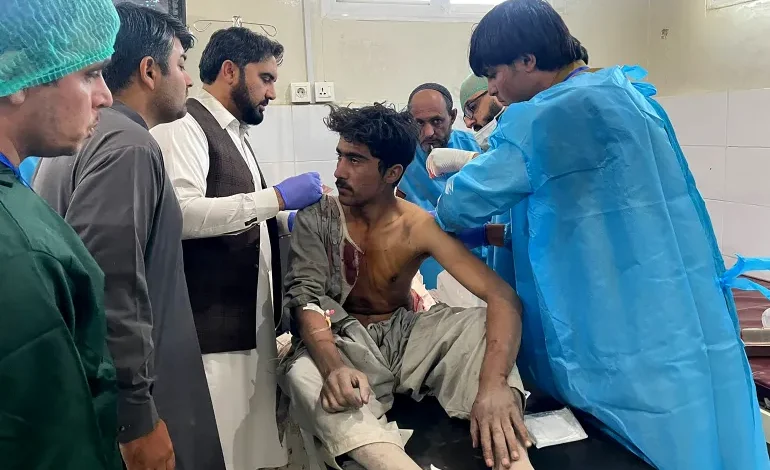
A fragile 48-hour ceasefire has been declared between Pakistan and Afghanistan after intense overnight clashes left dozens dead and wounded along the Chaman–Spin Boldak border. The keyword Pakistan-Afghanistan border clashes has again drawn global concern as both sides exchanged blame for triggering one of the deadliest confrontations in recent months.
48-Hour Ceasefire Agreement
Pakistan’s Foreign Ministry confirmed on Wednesday that both countries agreed to halt hostilities starting at 6 p.m. local time (13:00 GMT). Officials said the ceasefire would allow room for dialogue and peace efforts to resolve what they called a “complex yet resolvable” standoff. Islamabad emphasized that both governments had pledged to prevent further escalation and seek a peaceful solution.
Heavy Fighting Along the Frontier
The violence erupted late Tuesday in southeastern Afghanistan’s Spin Boldak district and Pakistan’s Chaman district. The border flare-up quickly intensified, lasting several hours and claiming multiple lives on both sides. According to local reports, civilians were among the most affected, as artillery and gunfire hit residential areas.
Eyewitnesses in Chaman described a night of fear. “Shells were falling in people’s homes,” said Najibullah Khan, a local resident. “People are in a very difficult situation. Many have fled their homes.”
Read: MTV Shuts Down Multiple UK Music Channels After Four Decades
Conflicting Claims from Both Sides
As is often the case in Pakistan-Afghanistan border clashes, both governments traded accusations over who started the fighting.
Taliban spokesman Zabihullah Mujahid alleged that Pakistani forces initiated the attack, using “light and heavy weapons” that killed 12 civilians and injured more than 100. Local Afghan officials later raised the death toll to 15, saying at least 80 women and children were among the injured. Mujahid claimed that Afghan forces retaliated, destroying Pakistani military posts, tanks, and equipment while inflicting “heavy losses” on the Pakistani side.
However, Islamabad rejected the accusations. Pakistani military officials said the Taliban fired first at a Pakistani border post and nearby civilian areas. They reported that six Pakistani soldiers were killed and four civilians wounded. “The insinuations that the attack was initiated by Pakistan are blatant lies,” said a military statement. “Our forces stand resolute and fully prepared to defend the sovereignty and territorial integrity of Pakistan.”
Pakistan’s Response
According to the army’s statement, Pakistani troops “effectively repulsed” the Taliban assault, killing 15 to 20 of their fighters. The military also reported neutralizing other Taliban attacks in Kurram district, further north along the border.
The statement reaffirmed Pakistan’s commitment to defending its borders, while expressing readiness to engage in dialogue if Afghanistan “acts responsibly.” Officials also hinted at the growing threat posed by militants crossing from Afghan territory, a long-standing concern for Islamabad.
Regional Reactions and Warnings
Al Jazeera correspondent Kamal Hyder, reporting from the Torkham border, described the incident as “a serious escalation” that could “lead to something much bigger.” He noted that civilians on both sides are growing increasingly anxious as the cycle of violence deepens.
The latest fighting follows months of rising tensions between the neighboring nations. Over the weekend, both armies exchanged heavy fire across multiple border regions, causing dozens of casualties. Appeals from Saudi Arabia and Qatar helped pause the earlier clashes, but the calm proved temporary.
Escalation and Diplomatic Strain
Relations between Islamabad and Kabul have deteriorated since the Taliban returned to power in 2021. Pakistan accuses the Afghan government of harboring militants from the Tehreek-e-Taliban Pakistan (TTP), a Taliban-allied group responsible for numerous attacks inside Pakistan. Kabul has repeatedly denied these allegations, insisting it does not allow its soil to be used against any other nation.
The Taliban government has countered that Pakistani airstrikes and cross-border shelling have violated Afghan sovereignty. Kabul claims it was forced to retaliate last week after “repeated Pakistani incursions.” Afghan officials said they targeted military outposts and killed 58 Pakistani soldiers, while Pakistan reported losing 23 troops but claimed to have killed more than 200 Taliban fighters in response.
Political and Security Implications
The recent border violence also comes amid diplomatic unease over Afghanistan’s outreach to India. Afghan Foreign Minister Amir Khan Muttaqi’s visit to New Delhi last week drew strong reactions in Islamabad. Analysts say the trip has further strained relations between Pakistan and Afghanistan, both of whom are navigating fragile political ties in the region.
Muttaqi, speaking at a press conference in India, said both nations desired “positive relations” but accused “certain groups in Pakistan” of fueling unrest. His remarks added to the growing mistrust between the two governments.
Kabul on Edge
Meanwhile, the Afghan capital witnessed further tension on Wednesday evening when two explosions rocked central Kabul. Taliban officials said the blasts were caused by an oil tanker and a generator explosion, sparking fires but causing no reported casualties. The incidents, though unrelated to the border violence, deepened public anxiety as fears of broader instability grow.
Outlook
As the ceasefire holds, even temporarily, both sides face pressure from regional powers and the international community to de-escalate. Yet, with civilians caught in the crossfire and years of unresolved grievances, lasting peace remains uncertain.
For now, the fragile truce along the Pakistan-Afghanistan border offers a brief pause in an increasingly volatile conflict — one that threatens not just the frontier communities of Chaman and Spin Boldak but the fragile stability of South Asia as a whole.
Follow us on Instagram, YouTube, Facebook,, X and TikTok for latest updates
