
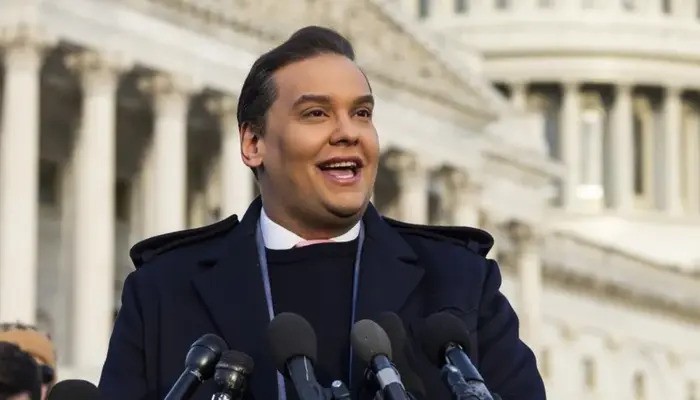
In a stunning political move, US President Donald Trump has commuted the prison sentence of former Republican congressman George Santos, who was serving seven years for fraud and identity theft. The Santos commutation has reignited debate over Trump’s use of presidential clemency and his loyalty to controversial Republican figures.
Trump’s Sudden Decision
Trump announced the decision late Friday on his social media platform, declaring, “George Santos has been horribly mistreated. Therefore, I just signed a commutation releasing him from prison immediately. Good luck George, have a great life!”
The former president’s statement ended months of speculation after Santos had repeatedly pleaded for leniency. His release came only hours after Trump’s post, with US media confirming that he was freed from a minimum-security prison in New Jersey.
One of Santos’s lawyers, Joseph Murray, thanked Trump for his decision, posting, “God bless President Donald J. Trump.”
Read: Mitch McConnell Falls in Senate Building After Questions
From Congress to Prison
George Santos’s political rise and fall became one of the most dramatic scandals in recent US history. In 2022, he was elected to represent a New York district that included parts of Long Island and Queens. His victory flipped a Democratic seat and made him one of the youngest Republican lawmakers in Congress.
However, within months, his fabricated past began to unravel. A New York Times investigation exposed lies about his education, work experience, and family background. He had falsely claimed to hold a university degree and to have worked at Citigroup and Goldman Sachs.
Soon, more troubling allegations surfaced. He was accused of stealing money from a fundraiser for a dying dog, lying about his mother surviving the 9/11 attacks, and misusing campaign funds for personal luxuries, including Botox treatments and OnlyFans subscriptions.
A Fall from Grace
By 2023, the House Ethics Committee released a scathing report accusing Santos of “blatant misuse” of campaign funds. The same year, Congress voted to expel him—making him only the sixth member in US history to be removed from the House.
Federal prosecutors charged him with 23 felony counts, including wire fraud, money laundering, and identity theft. He admitted to stealing the identities of 11 people, including some of his own family members.
During his sentencing hearing in April, Santos reportedly broke down in tears and begged for forgiveness. “I cannot rewrite the past,” he said, “but I can control the road ahead.” The judge, however, told him, “You got elected with your words—most of which were lies.”
Trump’s Justification
In his statement, Trump defended the decision to free Santos by drawing comparisons with Democratic Senator Richard Blumenthal. Trump accused Blumenthal of lying about his military record, saying, “This is far worse than what George Santos did, and at least Santos had the courage, conviction, and intelligence to always vote Republican!”
Blumenthal has previously acknowledged that he “misspoke” about his service record over a decade ago but noted that voters in Connecticut have since re-elected him multiple times. “This allegation of 15 years ago has been rejected by voters, overwhelmingly,” Blumenthal told CNN earlier this month.
A Plea for Forgiveness
Earlier this week, Santos had written an open letter to President Trump in the South Shore Press, titled “A Passionate Plea to President Trump.” In the letter, he begged for “the opportunity to return to my family, my friends, and my community.”
He revealed that he had been kept in solitary confinement after receiving death threats in August. Expressing remorse, he wrote, “Mr. President, I am not asking for sympathy. I am asking for fairness—for the chance to rebuild.”
Santos added that he had accepted responsibility for his actions but felt his punishment was excessive. “No man, no matter his flaws, deserves to be lost in the system, forgotten and unseen,” he wrote.
Legal and Political Reactions
Santos began his prison sentence in July and had served only a few months before being freed. Legal experts noted that a commutation—unlike a pardon—does not erase a conviction but only ends the prison term.
Critics of Trump’s decision called it a political gesture meant to rally Republican supporters ahead of the upcoming elections. Supporters, however, praised it as an act of compassion toward a man they say was unfairly targeted by the media and political establishment.
Trump’s Pattern of Clemency
This is not the first time Trump has used his presidential power to aid Republican figures facing criminal convictions. In May, he pardoned former congressman Michael Grimm, who had pleaded guilty to tax fraud in 2014. He also pardoned former Connecticut governor John Rowland, convicted of corruption and fraud in 2004.
Analysts view the Santos commutation as part of Trump’s broader effort to reward loyalty within the Republican ranks. His actions signal a continued defiance of political norms and a desire to reshape the boundaries of presidential power.
A Divisive Legacy
For Santos, the commutation offers a second chance, though his political future remains uncertain. His reputation, damaged by lies and scandals, leaves little room for a return to public office. Yet, his release has made him a symbol in Trump’s ongoing battle against what he describes as “unfair persecution” of conservatives.
Trump’s decision to free George Santos has once again thrust the former congressman into the national spotlight—this time as the latest beneficiary of presidential mercy. Whether it will help or hurt Trump politically remains to be seen, but one thing is clear: both men now share a complicated legacy defined by controversy, loyalty, and defiance.
Follow us on Instagram, YouTube, Facebook,, X and TikTok for latest updates
