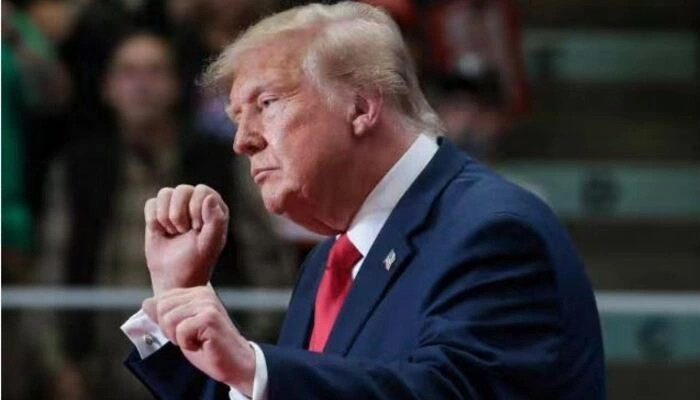
US President Donald Trump intensified his attacks on Senate candidate Abdul El-Sayed at a campaign rally in Michigan on Sunday, comparing the Democrat to the hijackers involved in the September 11, 2001, attacks and accusing Democrats of allowing anti-American extremists into the United States.
Trump made the remarks in Port Huron as Michigan prepared for the November 3 midterm elections, with the state’s competitive Senate race emerging as a key contest in determining control of Congress.
“I’m here to keep a jihadist, Muslim Brotherhood member from becoming a United States senator,” Trump told supporters at the rally, according to Reuters.
El-Sayed, a Democrat seeking an open Senate seat, has rejected accusations that he has links to the Muslim Brotherhood or holds extremist loyalties. No evidence was presented in the reported remarks to substantiate the allegations.
The controversy has intensified political divisions in Michigan, where Republicans and Democrats are competing for a seat that could influence the balance of power in the US Senate.
Trump Invokes September 11 Attacks Against Abdul El-Sayed
Trump escalated his criticism by invoking the September 11 attacks and comparing opposition to El-Sayed’s candidacy with the actions of passengers who resisted hijackers aboard United Airlines Flight 93.
The president referred to Todd Beamer, a Michigan native who became widely known for his role in the passengers’ resistance during the 2001 hijacking.
“Twenty-five years later, Michigan needs to stand up and fight, just like Todd did, to stop a jihadist from walking into the Capitol,” Trump said.
Trump also suggested that El-Sayed would face extraordinary security restrictions if elected, claiming he would be the only senator required to pass through a metal detector before entering the Senate.
The remarks drew cheers from sections of the predominantly White audience in Port Huron. Some attendees shouted “traitor” and “deport,” despite El-Sayed’s birth in Michigan.
Trump has repeatedly portrayed El-Sayed as an anti-American radical, making the candidate’s Muslim identity a central feature of his attacks.
The comments have placed renewed attention on the use of religious identity and national security allegations in the closely contested Senate campaign.
Abdul El-Sayed Rejects Muslim Brotherhood Allegations
El-Sayed has denied any affiliation with the Muslim Brotherhood and criticised attempts to question his loyalty to the United States.
Republican candidate Mike Rogers has also raised allegations about El-Sayed’s supposed connections to the organisation, but the claims have not been substantiated in the reported account.
Rogers, a former US representative, sought to distance himself from the most extreme accusations during an appearance on NBC’s Meet the Press on Sunday.
“I’ve never called him a terrorist,” Rogers said when asked about the claims surrounding El-Sayed.
However, Rogers argued that El-Sayed had not adequately addressed questions about the allegations. He also described the candidate as aligned with the Democratic Socialists of America and claimed some of his support groups held radical views.
El-Sayed has rejected suggestions that his political affiliations undermine his allegiance to the country, describing questions about his patriotism as shameful.
The dispute has become a defining issue in a race where both parties are seeking to mobilise voters ahead of election day.
El-Sayed Criticises Trump Over Foreign Financial Ties
Speaking at an event in Grand Rapids on Sunday night, El-Sayed responded to Trump’s criticism by questioning the president’s apparent attitude towards Muslim-majority countries and their financial relationships with his family.
“I get that the president of the United States takes personal offense to my first name,” El-Sayed told the audience.
He argued that Trump did not express similar concerns when Saudi-linked funding supported an investment fund associated with his son-in-law, Jared Kushner, or when Qatar provided the president with a Boeing 747 aircraft.
Kushner’s investment firm, Affinity Partners, has reportedly received billions of dollars from a Saudi government entity. Qatar also provided Trump with a Boeing 747 jet, an arrangement that has attracted public scrutiny.
El-Sayed’s response sought to challenge the president’s criticism by highlighting what he described as inconsistent attitudes towards foreign relationships involving Muslim-majority countries.
The exchange added another dimension to the campaign, moving beyond questions about El-Sayed’s political views to include foreign investment, presidential ethics and the treatment of Muslim Americans.
Barack Obama Defends El-Sayed at Detroit Rally
The dispute intensified after former US president Barack Obama campaigned for Democrats in Michigan on Saturday.
At a rally in Detroit, Obama criticised efforts to portray El-Sayed as less American than his political opponents, comparing the attacks to false claims about Obama’s own birthplace.
Obama, who faced years of false claims that he was born in Kenya, expressed confidence that similar political tactics would not succeed against El-Sayed.
“This stuff didn’t work on me,” Obama said. “Not in Michigan. It’s not going to work on Abdul.”
Obama’s appearance underscored Michigan’s importance to Democrats as they attempt to challenge Republican control of Congress.
The state has one of the country’s most competitive Senate contests, with El-Sayed facing Rogers for an open seat that could help determine which party controls the chamber.
Read more: Chiefs vs Seahawks: Seattle Stun Kansas City With Dominant Defensive Display
Michigan Senate Race Could Influence Control of Congress
The Michigan contest is part of a broader battle for congressional control in the November 3 midterm elections.
According to the figures provided in the report, Republicans hold a narrow 53-47 majority in the Senate and a 218-214 majority in the House of Representatives, with a small number of seats separating the parties.
Democrats are seeking to gain seats in both chambers, making competitive states such as Michigan particularly important.
If elected, El-Sayed would become the first Muslim elected to the US Senate, according to the supplied report. His candidacy has therefore attracted national attention, particularly as Trump’s criticism has increasingly focused on his religion and alleged affiliations.
The race now highlights wider questions about religious discrimination, political rhetoric, national security claims and the role of identity in American elections.
As November 3 approaches, the candidates and their allies face mounting pressure to persuade voters in a state that could play a decisive role in shaping the next phase of US politics.